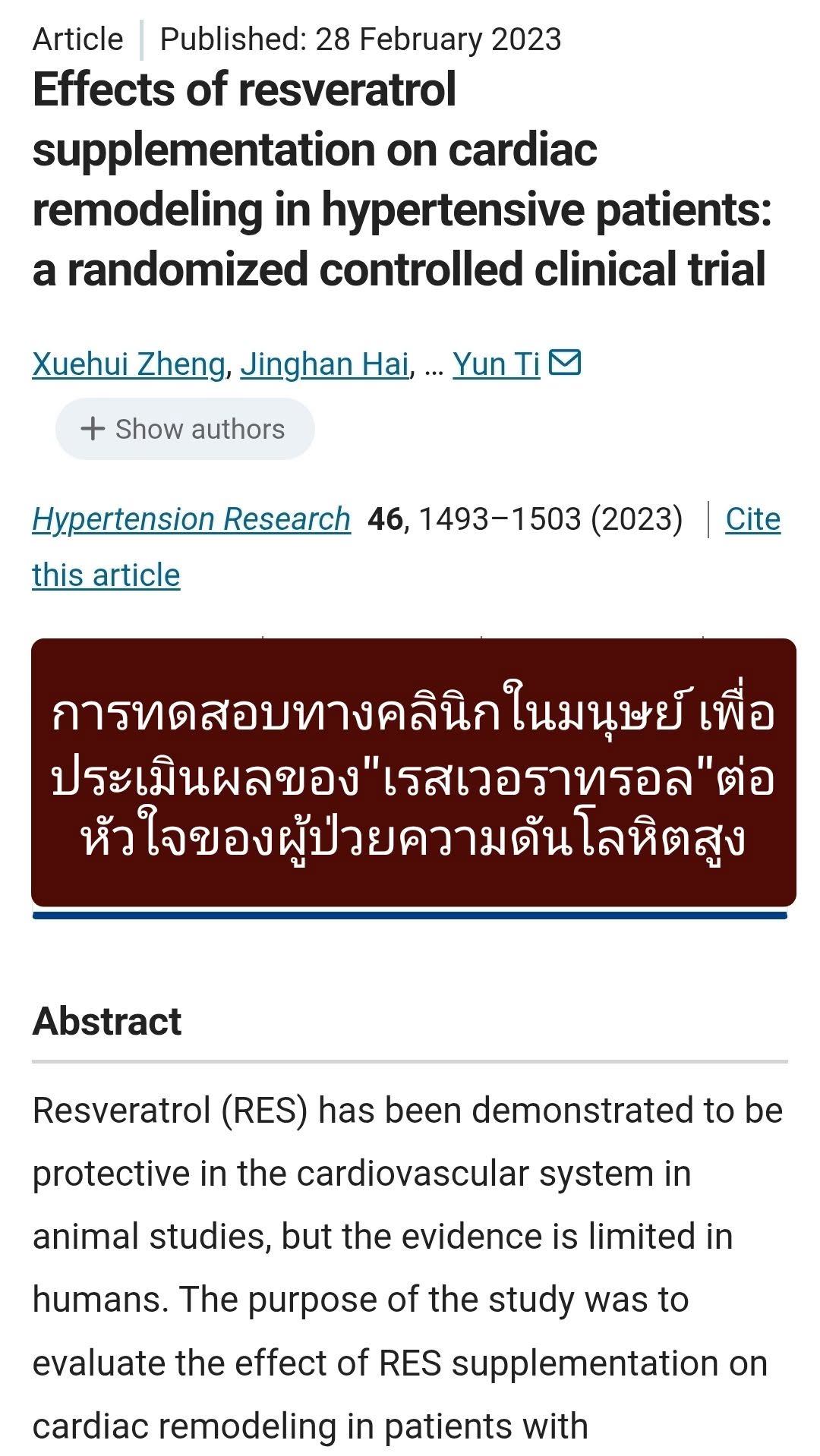
Published in the journal Nature Publishing Group titled “Effects of resveratrol supplementation on cardiac remodeling in hyper...
Summary of the article published in the journal Nature Publishing Group titled “Effects of resveratrol supplementation on cardiac remodeling in hypertensive patients: a randomized controlled clinical trial” which is a randomized controlled clinical trial (Randomized Controlled Trial) to evaluate the effect of resveratrol on the heart of hypertensive patients.
Easy to understand summary:
Objectives of study:
Researchers wanted to know if resveratrol, an antioxidant found in red grapes, and mulberry Can it help reduce cardiac remodeling caused by high blood pressure?
When you have high blood pressure for a long time The heart will work harder, resulting in:
- The left atrium is enlarged.
- thickened heart muscle
- The heart doesn't relax well.
- Fibrosis in the heart muscle
Educational format
Total participants: 80 people with high blood pressure, divided into 2 groups.
● Resveratrol group: 43 people received Resveratrol 400 mg/day plus standard treatment.
● Control group: 37 people receiving standard treatment only.
Study period: 6 months
Important study results:
1. Reduce left atrium enlargement.
The size of the left atrium decreases. Shows that the heart can handle pressure better.
2. Improves heart function
The E/e′ value decreases, which means the heart relaxes better. and the pressure in the heart decreases
3. Increase the efficiency of heart muscle contraction.
Improved Global Longitudinal Strain (GLS), which is a measure of heart muscle strength.
4. Reduce fibrosis in the heart
Biomarkers associated with fibrosis include:
Procollagen type I C-peptide (PICP)
Galectin-3
significantly decreased
5. Add substances protecting heart cells
Sirtuin-3 (SIRT3) levels
Superoxide dismutase (SOD)
Klotho
increased, which is associated with reducing oxidative stress and delaying cell degeneration.
Things clearly haven't changed.
The size and thickness of the left ventricle were not significantly different.
Blood pressure did not decrease more pronounced than in the control group.
Therefore, the main benefit of Resveratrol is to protect the structure and function of the heart. rather than directly reducing pressure numbers.
Mechanism of action
Resveratrol helps:
☆ Reduce inflammation
☆ Antioxidants
☆ stimulates SIRT3
☆ Increases the function of mitochondria.
☆ Reduce fibrosis in the heart muscle.
Researchers' conclusions:
Resveratrol 400 mg/day for 6 months can:
■ Reduce cardiac changes from high blood pressure.
■ Improves cardiac relaxation.
■ Reduces myocardial fibrosis.
■ Helps reduce the risk of future heart failure.
The researchers concluded that Resveratrol can be used as Complementing standard treatment In patients with heart disease from high blood pressure.
Clinical meaning:
This study is very important. This is because one of the studies in humans has shown that Resveratrol not only helps fight free radicals, but also helps:
• Protect the heart.
• Reduces fibrosis.
• Slow down the deterioration of the heart muscle.
Brief summary
> “Clinical research in hypertensive patients found that taking Resveratrol continuously for 6 months reduces heart deterioration. improve heart function and reduce fibrosis in the heart muscle This reduces the risk of heart failure in the future.”