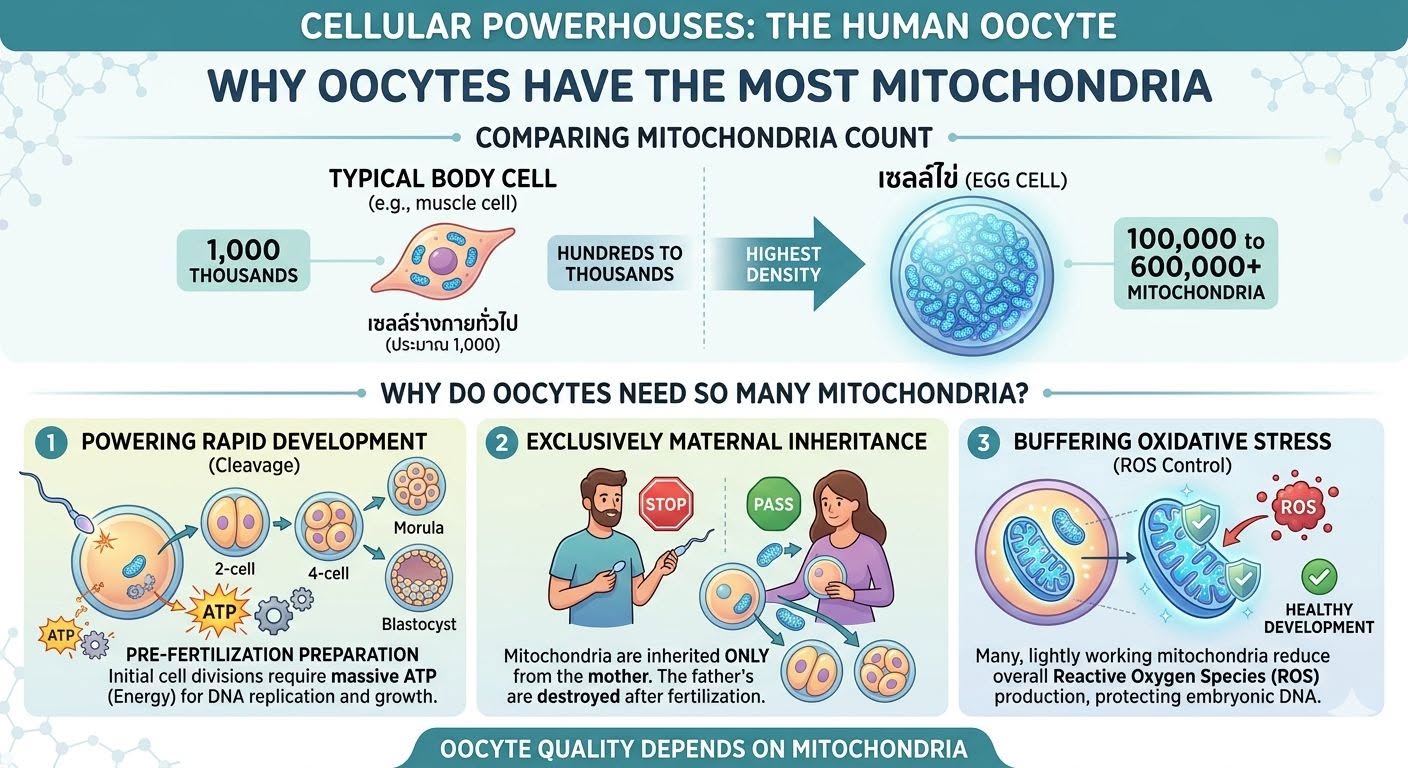
Egg cells (Oocytes) are considered the most special and largest cells in the human body. And what's amazing is that it's a cell that has...
Egg cells (Oocytes) are considered the most special and largest cells in the human body. And what's amazing is that it's a cell that's dense with mitochondria. (Mitochondria) is the highest. In one complete egg cell there may be up to 100,000 to 600,000 mitochondria, while normal cells such as muscle cells or brain cells There will only be hundreds to thousands of units.
The reasons and mechanisms that cause egg cells to accumulate enormous amounts of mitochondria are as follows.
1. Preparation for cell division after fertilization
After the sperm fertilizes the egg cell The embryo begins a rapid process of dividing from 1 to 2, 4, 8, and so on. This process is called Cleavage, which requires very high amounts of ATP to build new organelles and replicate DNA.
Mechanism: In the early stages of development (approximately the first 5-6 days), the dividing embryo is not yet able to create new mitochondria on its own. It relies solely on "cost" or inherited mitochondria that the mother stores in the egg cell. If there aren't enough of them, cell division is disrupted and the embryo may atrophy.
2. The embryo's only source of energy (Maternal Inheritance)
According to the laws of genetics Almost all of our mitochondria are inherited from our mother alone. This is because the mitochondria in sperm are often destroyed after fertilization.
Mechanism: The egg cell must therefore "reserve" enough mitochondria for the offspring cells. every cell that will occur in the future To ensure that various organs Your baby will have a complete energy power plant.
3. Controlling Reactive Oxygen Species (ROS) levels
Even though mitochondria create energy But it also creates waste products such as free radicals (ROS), which can damage the DNA of the embryo.
Mechanism: Having a large number of mitochondria but keeping each unit at a "low membrane potential" is a strategy of the egg cell to reduce ROS production, helping to protect the genetic information that will be passed on to offspring as safely as possible.
Summary of biological mechanisms
During the development of the egg cell (Oogenesis), a process called Intensive Mitochondrial Biogenesis to expand the number of mitochondria from hundreds to hundreds of thousands.
Trivia: Quantity and quality of mitochondria in egg cells. Therefore it is an important indicator of "Egg Quality" in medicine especially in reproductive technology