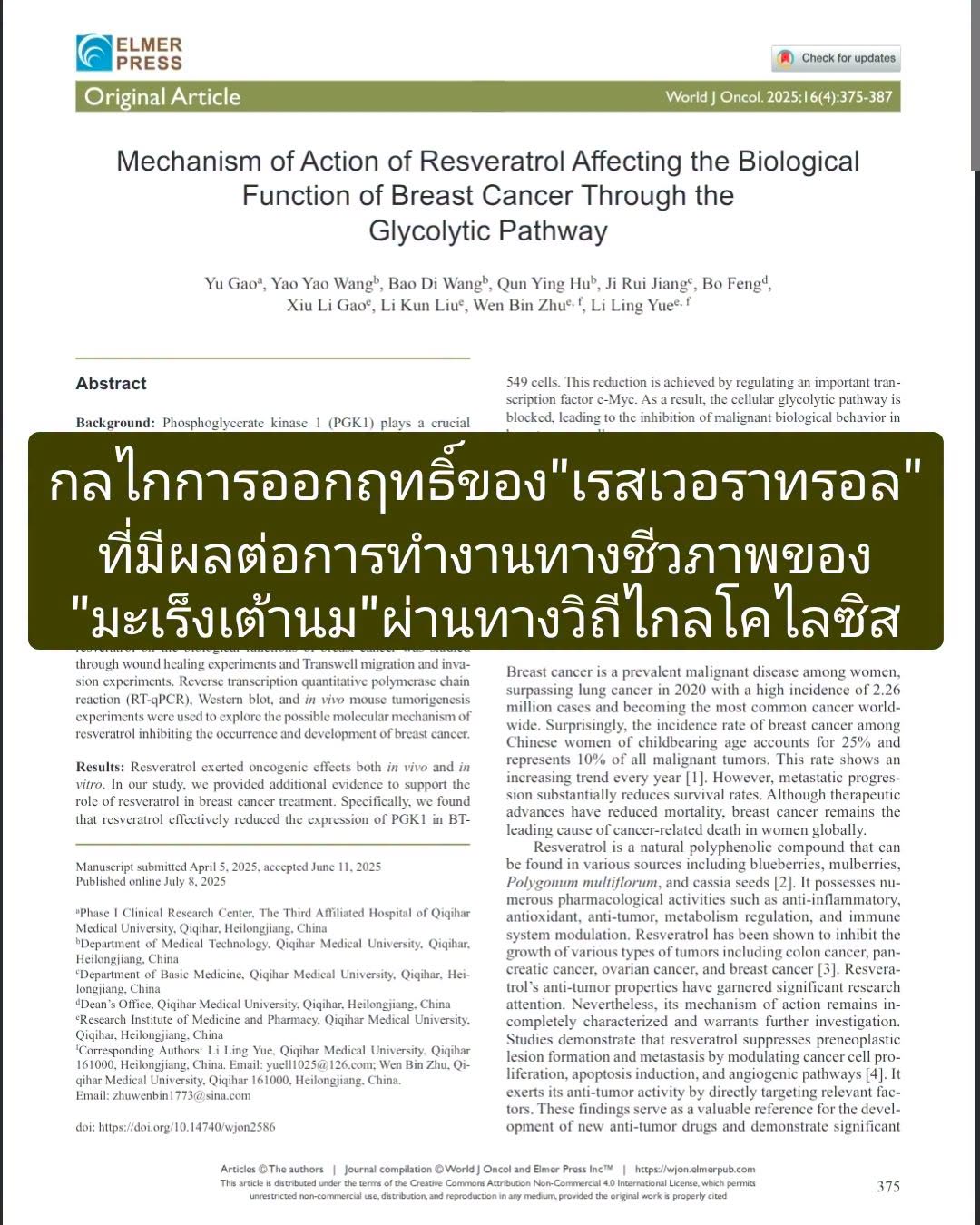
: Mechanism of Action of Resveratrol Affecting the Biological Function of Breast Cancer Through the Glycolytic Pathway
Article summary: Mechanism of Action of Resveratrol Affecting the Biological Function of Breast Cancer Through the Glycolytic Pathway
Published in World Journal of Oncology (2025)
Objectives of the study
This research examines the mechanism by which resveratrol (a polyphenol found in mulberries, red grapes, and some plants) can inhibit the growth and spread of breast cancer. It focuses on interfering with the Glycolysis process (sugar metabolism of cancer cells) through the enzyme PGK1 (Phosphoglycerate Kinase 1), which is an important enzyme in generating energy in cancer cells.
Important principles
Cancer cells are characterized by using large amounts of glucose to create energy. Even in conditions where there is enough oxygen, which is called the Warburg Effect, cancer cells can grow and spread quickly.
Researchers found that
● PGK1 is highly expressed in various breast cancer tissues.
● Patients with high PGK1 levels tend to have a worse prognosis.
● PGK1 is therefore an important target for breast cancer treatment.
Resveratrol Mechanism of Action
Research has found that Resveratrol can:
1. Reduces the activity of c-Myc.
c-Myc is a protein that regulates the expression of several genes involved in cancer growth.
2. Reduce the production of PGK1
When c-Myc is decreased, PGK1 production is decreased accordingly.
3. Inhibits Glycolysis
When PGK1 is reduced, cancer cells' ability to make energy from glucose is disrupted.
4. Cancer cells lack energy.
resulting in
- division decreased
- Movement (Migration) decreased.
- Tissue invasion (Invasion) reduced
- Increased cell death (Apoptosis)
Experimental results
Resveratrol can
Reduce the movement of cancer cells
Reduced ability to invade tissue
Reduced expression of PGK1
Reduced c-Myc expression
Inhibits proteins involved in cancer metastasis, such as MMP2 and MMP9.
Brief mechanism diagram
Resveratrol
Reduce c-Myc
Reduce PGK1
Inhibits Glycolysis
Reduce energy production of cancer cells
Reduce growth + reduce spread + increase cancer cell death
Academic conclusion
This research suggests that Resveratrol is a natural substance that has the potential to inhibit breast cancer through altering the metabolism of cancer cells. Specifically, it inhibits the c-Myc → PGK1 → Glycolysis axis, a key pathway used by cancer cells to generate energy and spread disease.
This article provides new evidence that resveratrol extracted from mulberry has the potential to inhibit the energy metabolism of breast cancer cells through reducing PGK1 and c-Myc, which are important targets of modern cancer research.