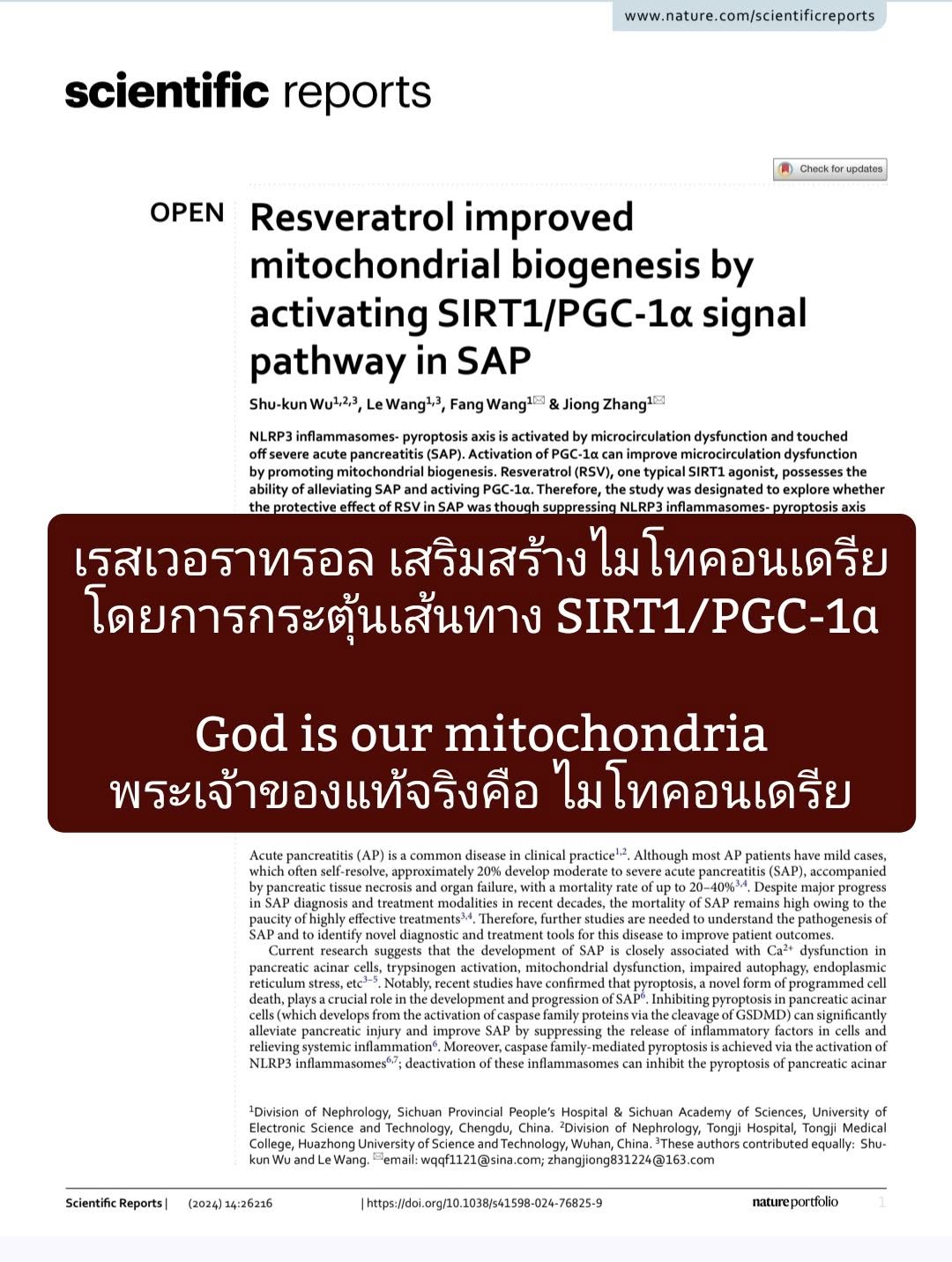
Research from the article in Scientific Reports on
Summary of research from articles in Scientific Reports on
“Resveratrol improved mitochondrial biogenesis by activating SIRT1/PGC-1α pathway in SAP”
Research overview
Studying the effects of Resveratrol (RSV) on SAP (Severe Acute Pancreatitis), emphasizing that Resveratrol helps “restore mitochondria. (mitochondria)” or not
Important mechanism discovered
1. Resveratrol stimulates the creation of new mitochondria.
Increase the expression of important proteins including
PGC-1α (master regulator of mitochondrial biogenesis)
NRF-1
TFAM
Make:
The amount of mtDNA increases
Mitochondrial function improves
Conclusion: Cells can “create new energy factories” for more
2. Mechanism through SIRT1/PGC-1α pathway
RSV stimulates SIRT1.
SIRT1 will:
Reduced acetylation of PGC-1α
Makes PGC-1α work better
This results in the creation of more mitochondria.
Simple explanation:
Resveratrol → Turns on SIRT1 → Turns on PGC-1α → Increases cellular energy.
3. Confirm that this mechanism is “really necessary”
If to “block” SIRT1 or PGC-1α:
The good effects of Resveratrol disappear
If “add” PGC-1α:
Resveratrol's beneficial effects come back stronger
This means that this path is the heart of the results.
4. Reduce inflammation and cell death
Resveratrol reduces the activity of the NLRP3 inflammasome (inflammatory activator).
Reduce pyroptosis cell death
Makes cells survive more
The shortest summary
Resveratrol helps restore mitochondria.
It works through the SIRT1 → PGC-1α → NRF1/TFAM pathway.
Resulting in:
Better cell energy
Reduce inflammation
Protecting cells in SAP disease
Important Insight (health related)
Mitochondria = energy source of the cell.
This work indicates that Resveratrol:
Helps with diseases related to “Abnormal cell energy”
such as inflammatory, metabolic, or degenerative diseases.