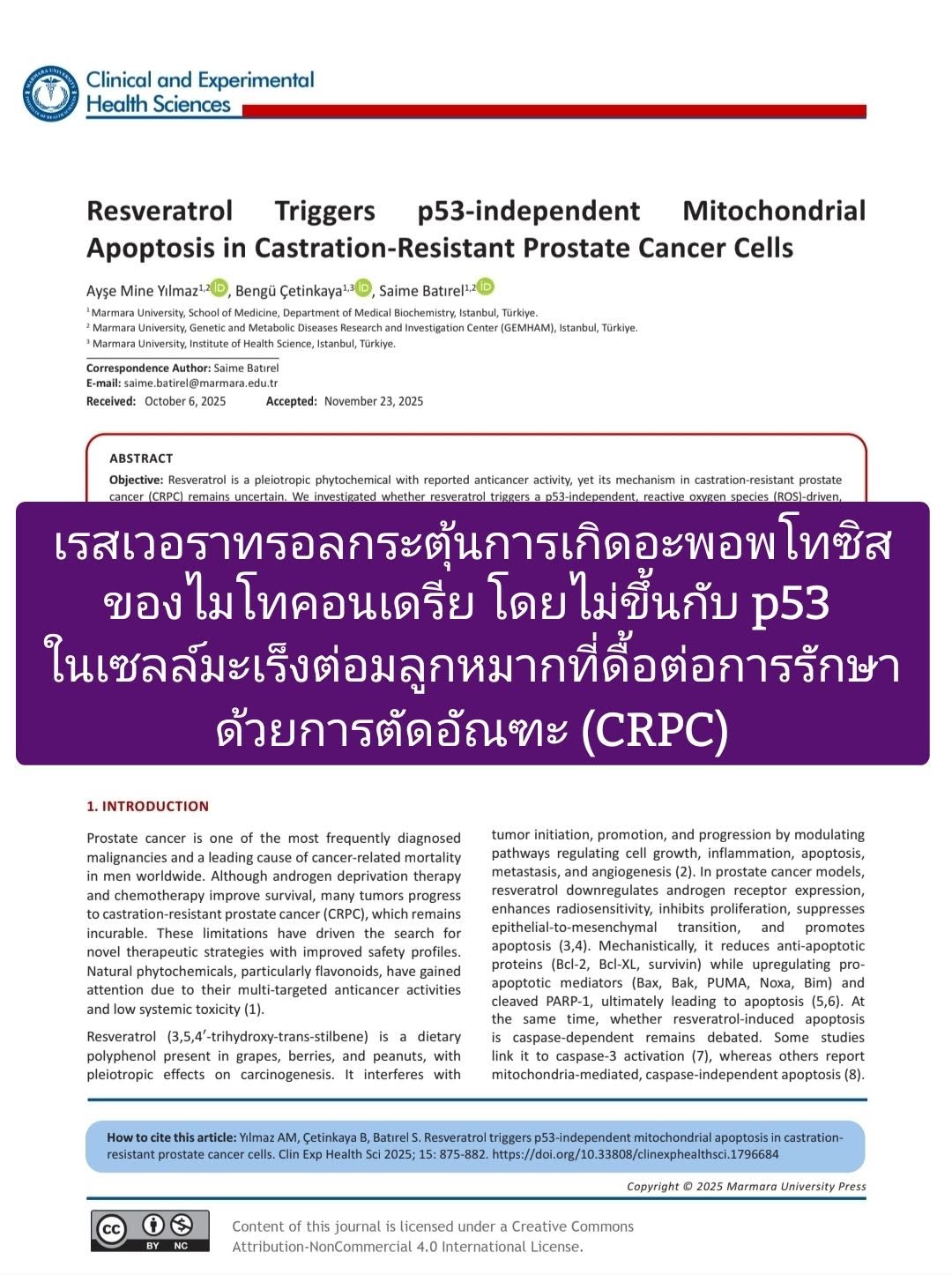
“Resveratrol Triggers p53-Independent Mitochondrial Apoptosis in Castration-Resistant Prostate Cancer Cells” จากวารสา...
Summary of the article “Resveratrol Triggers p53-Independent Mitochondrial Apoptosis in Castration-Resistant Prostate Cancer Cells” from the journal Clinical and Experimental Health Sciences.
Research objectives
This research studies whether Resveratrol (Resveratrol), a natural polyphenol, Can stimulate the death of prostate cancer cells resistant to hormone therapy. (Castration-Resistant Prostate Cancer: CRPC), especially wanting to prove that Cell death occurs through an increase in Reactive Oxygen Species (ROS).
Mitochondrial damage, Apoptosis process (programmed death)
and occurs without relying on p53 (p53-independent)
This is very important because this type of cancer cell often has abnormalities in p53, making it difficult to treat.
Experimental method
Researchers used prostate cancer cell line DU145 (a CRPC cell line).
Expose to Resveratrol for 24 hours and then test.
Cell viability → Cell viability (MTT assay)
Apoptosis → cell death (Annexin V/PI flow cytometry)
ROS levels → amount of free radicals in the cell
Mitochondrial membrane potential → Mitochondrial integrity (JC-1 staining)
Important proteins include:
PARP-1
NF-κB p50
p53
by Western blot technique
Important research results
1. Resveratrol markedly reduces cancer cell survival.
when using a concentration of 200 µM
Only about 56% of the cells were left alive, indicating that Resveratrol had a clear effect on inhibiting the growth of cancer cells.
2. Increase Apoptosis
It was found that cells treated with Resveratrol had a significant increase in the number of cells that entered apoptosis, meaning that Resveratrol did not just stop growth but “stimulated the death of cancer cells.”
3. ROS increases.
Intracellular ROS levels greatly increased.
Excessive ROS damages the mitochondria. and stimulate cell death signals
4. Mitochondria are out of balance.
JC-1 assay found that
Mitochondrial membrane depolarization occurs.
This means that the mitochondria have lost their ability to function.
which is an important sign of mitochondrial apoptosis pathway
5. PARP-1 is cut (cleavage)
They found a decrease in full-length PARP-1 and an increase in cleaved PARP. This is evidence of caspase activation, confirming that cells are indeed entering apoptosis.
6. p53 does not change
p53 levels hardly change
But apoptosis can still occur.
Therefore it is concluded that it is “p53-independent apoptosis”
This is very important in cancers where p53 is abnormal, such as DU145 cells.
Conclusion of the research
Resveratrol can stimulate the death of hormone-resistant prostate cancer cells through the
ROS ↑ → Mitochondrial dysfunction → Caspase activation → Apoptosis
It does not require p53 and therefore has the potential to be an adjuvant in treating treatment-resistant prostate cancer (CRPC) in the future.
Brief summary
“Resveratrol kills hormone-resistant prostate cancer cells. through mitochondrial damage and increasing ROS without relying on p53.”