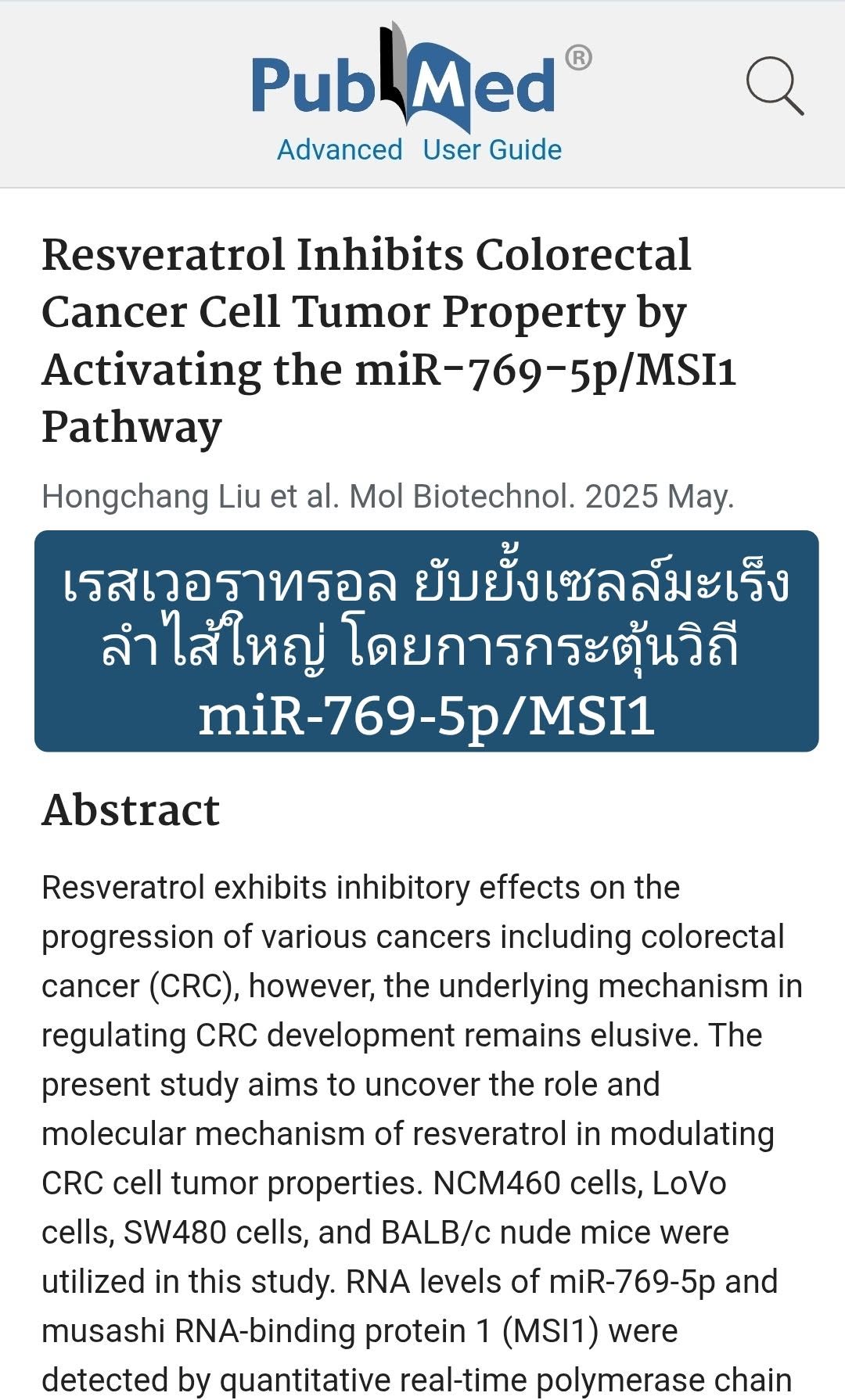
Summary of the article
“Resveratrol Inhibits Colorectal Cancer Cell Tumor Property by Activating the miR-769-5p/MSI1 Pathway”
Published in the journal Molecular Biotechnology (2025)
Research objectives
This research studied whether Resveratrol (a natural polyphenol found in red grape skins) and mulberry) can inhibit the growth of How can colon cancer (Colorectal Cancer (CRC)) be determined by emphasizing the molecular mechanisms through the path?
miR-769-5p/MSI1 pathway
Method of study
Researchers use
Colon cancer cells LoVo and SW480
Normal cell NCM460
BALB/c nude mice
Do an inspection
increasing the number of cancer cells
Cell death (apoptosis)
cell movement and spread
Expression of miR-769-5p and MSI1
cancer tumor formation
Important research results
1. In colon cancer, it was found that
miR-769-5p is lower
MSI1 higher
which is related to the growth of cancer
2. Resveratrol helps
Increased miR-769-5p levels
Downgrade MSI1
resulting in
Reduce the division of cancer cells
Reduce movement and spread
Increases the death of cancer cells
3. When Resveratrol is used together with increasing miR-769-5p
Anti-cancer effect "stronger"
It shows that miR-769-5p is an important mechanism that enhances the effects of Resveratrol.
4. MSI1 is a direct target of miR-769-5p.
When MSI1 is pressed down
→ Cancer cells grow more slowly.
But if adding MSI1 back in
→ Resveratrol's anti-cancer effect decreases.
Conclusion of the research
Resveratrol can stop colon cancer by
stimulate
miR-769-5p
and go press
MSI1
resulting in
reduce growth
reduce spread
Increases the death of cancer cells
Therefore has the potential to develop into Future adjuvants for colon cancer treatment
The simplest summary
Resveratrol
→ Turn on the “cancer suppression” switch (miR-769-5p)
and turn off the “accelerating cancer” switch (MSI1)
The result is
Cancer grows more slowly and more die
This research supports the idea that
Natural resveratrol plays an important role in the prevention and enhancement of colon cancer treatment.