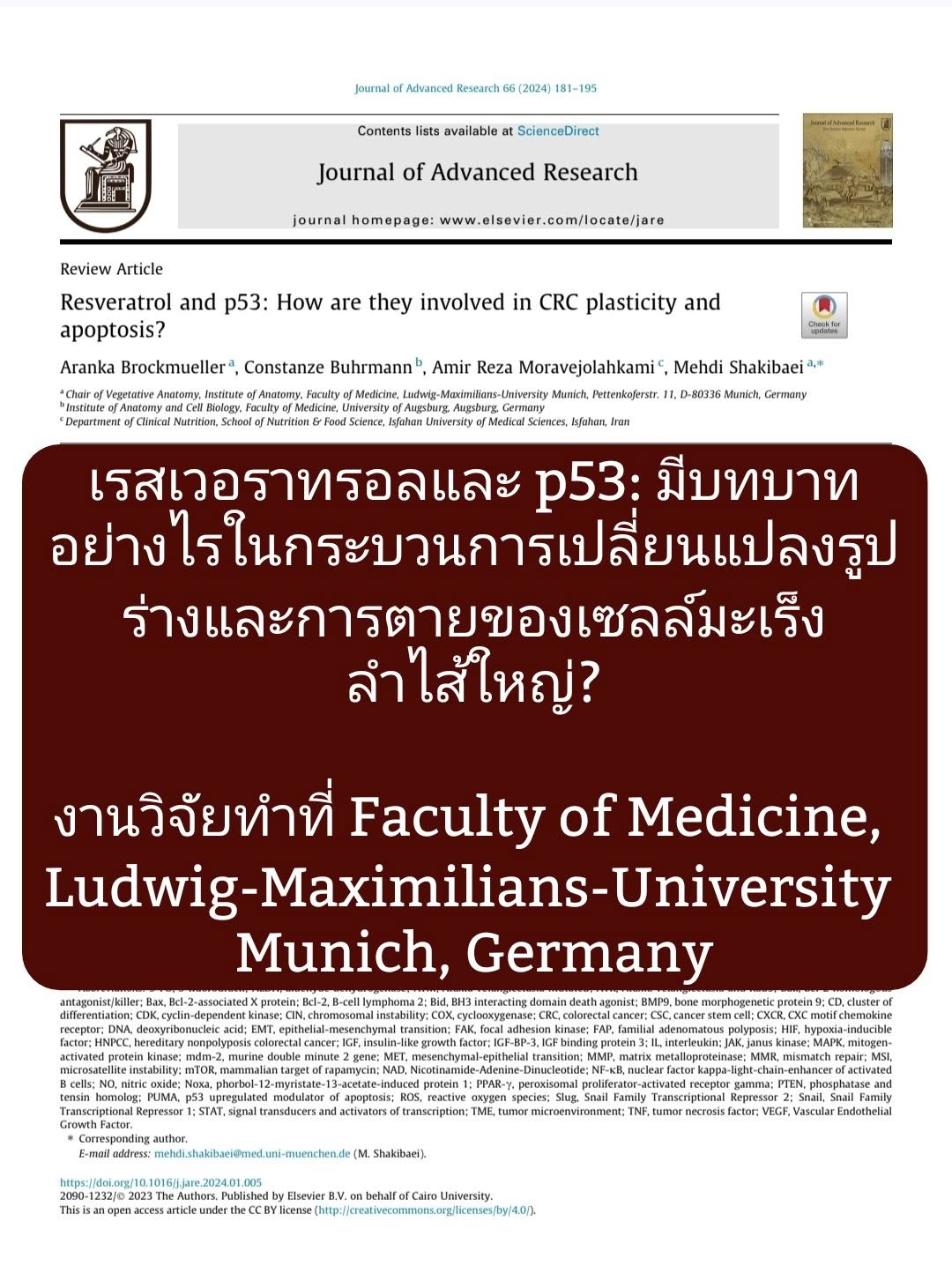
“Resveratrol and p53: How are they involved in CRC plasticity and apoptosis?”
Summary of the article “Resveratrol and p53: How are they involved in CRC plasticity and apoptosis?”
From ScienceDirect
This article is a review explaining the role of Resveratrol (polyphenols from the skin of red grapes, mulberries, etc.) in prevention and treatment. Colorectal Cancer (CRC) with emphasis on the relationship with p53 protein, which is an important tumor suppressor, also known as the “guardian of the genome.”
The main points of the article
1. CRC is related to “Tumor Cell Plasticity”
CRC is not caused by genetics alone. but related to
lifestyle habits
chronic inflammation
epigenetic factors
DNA repair abnormalities
What is important is that cancer cells have plasticity or the ability to “Change yourself to survive,” for example.
EMT (epithelial-mesenchymal transition)
Birth of Cancer Stem Cells (CSCs)
metabolic reprogramming
The result is
Drug resistant
Metastases (metastasis)
increase the severity of the disease
2. p53 is a key regulator of cancer resistance.
p53 functions
Stop cell cycle
DNA repair
stimulate apoptosis
Reduce EMT
Reduce CSC formation
Inhibits inflammation through NF-κB
If p53 loses its function, it causes
More cancer cells survive
EMT increased
increased stemness
Metastasis occurs more easily.
3. Resveratrol helps “activate” p53.
Resveratrol is effective
anti-inflammatory
Antioxidants
Resists the division of cancer cells
reduce spread
increase apoptosis
The important mechanism is
Stimulates p53 signaling pathway
By helping
Increase p53 expression
Increase p53 stability
Reduced inhibition from MDM2
Stimulates ATM/ATR pathway
Stimulate p38/MAPK pathway
Add Bax / PUMA / Noxa
Reduce Bcl-2
cause
mitochondrial apoptosis pathway
is
Bax ↑
→ cytochrome C release ↑
→ caspase-3 activation ↑
→ cancer cell death ↑
4. Resveratrol reduces EMT and Cancer Stem Cells.
Resveratrol reduces markers of EMT such as
Snail
Slug
Vimentin
Paxillin
and add
E-cadherin
The result is
Reduce cell movement
Reduce intrusion
reduce spread
Including reducing CSC markers such as
ALDH
CD44
stemness signaling
Thus reducing the chance of recurrence and drug resistance.
5. Has the potential to be a co-therapy with chemotherapy.
The article suggests that Resveratrol may be used in combination with medications such as:
5-FU
Oxaliplatin
to help
Increase treatment efficiency
Reduce chemoresistance
Reduce side effects
increases response to medication
Brief summary
“Resveratrol uses p53 as the key.”
to
Reduce plasticity
→ Reduce EMT + Reduce CSC + Reduce metastasis
and
increase apoptosis
→ Causes cancer cells to die.
Therefore it is both a prophylactic agent (prevention).
co-therapeutic agent (additional treatment)
for CRC in the future
Summary of health business
If used with health products such as Resveratrol extracted from mulberries.
Can communicate that
“Helps support the mechanism of protection against abnormal cells through the p53 pathway.”
“Reduces inflammation and conditions that promote cancer.”
“It helps to enhance the body's natural apoptosis system.”