Summary of the article
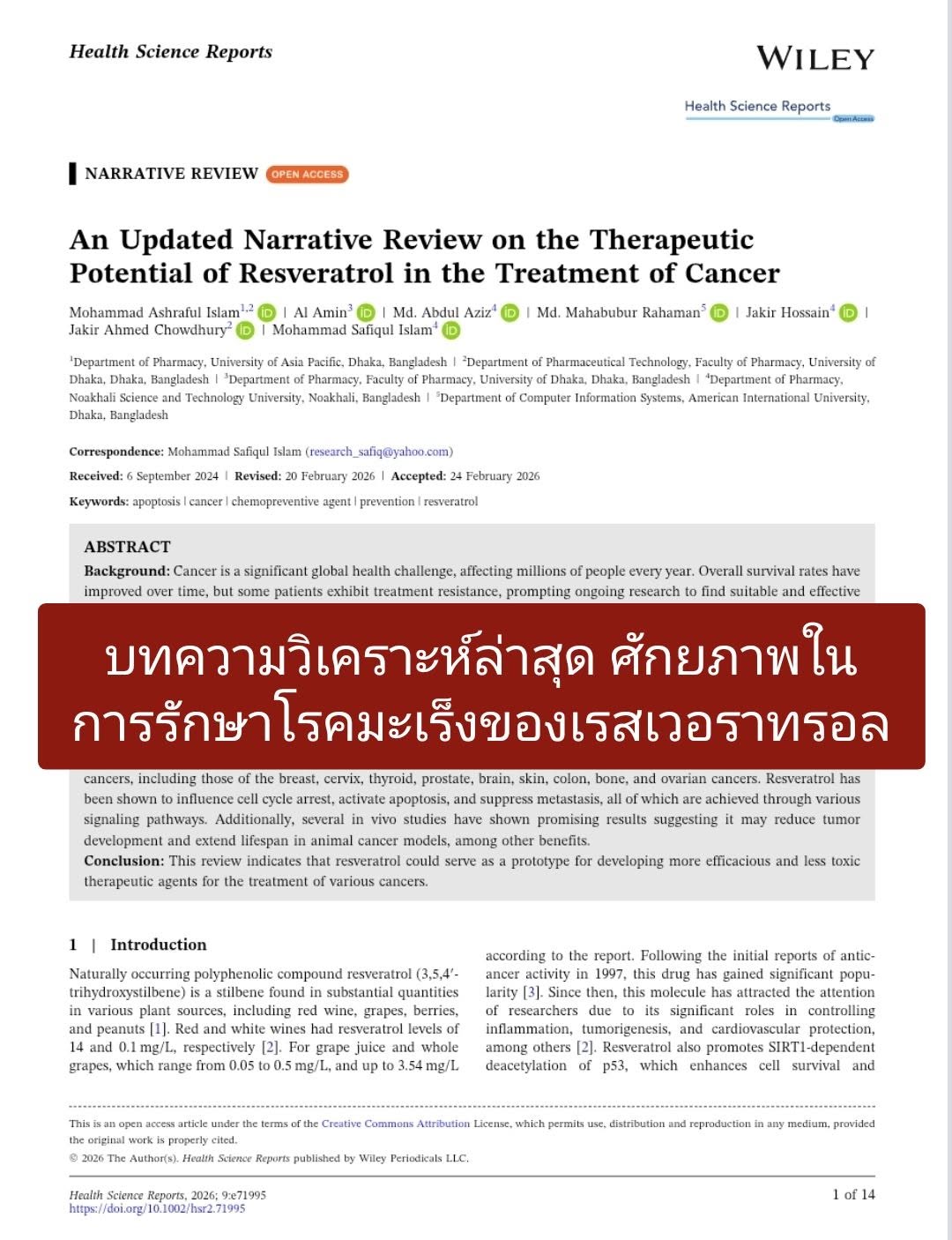
“An Updated Narrative Review on the Therapeutic Potential of Resveratrol in the Treatment of Cancer”
(2026) published in the journal Health Science Reports.
This article is a review of the latest literature on “Resveratrol (Resveratrol)” which is a natural polyphenol found in the skin of red grapes, mulberries and some plants. Focusing on the potential for use in treating and preventing cancer.
1. Importance of Resveratrol
Resveratrol is a substance in the stilbene group with the chemical name 3,5,4′-trihydroxystilbene There are outstanding features:
- Antioxidants (Antioxidant)
- anti-inflammatory (Anti-inflammatory)
- Prevent heart disease (Cardioprotective)
- Anti-aging (Anti-aging)
- Anticancer (Anticancer)
Resveratrol has received a lot of attention after its anti-cancer properties were discovered in 1997, and is now considered an important prototype for the development of new anti-cancer drugs, the researchers said.
2. Main anti-cancer mechanisms
Resveratrol can inhibit cancer through several mechanisms, including:
2.1 Stop the cell cycle (Cell Cycle Arrest)
Helps stop the division of cancer cells. Makes cells unable to increase in number
2.2 Stimulate the death of cancer cells (Apoptosis)
Helps cancer cells enter the natural death process.
2.3 Inhibit the spread (Anti-metastasis)
Reduce the progression and spread of cancer to other organs.
2.4 Resists the creation of new blood vessels (Anti-angiogenesis)
Reduce the creation of new blood vessels that nourish the tumor.
2.5 Adjust the immune system (Immunomodulation)
Helps increase the activity of NK cells and T-cells to eliminate cancer cells.
2.6 Reduce inflammation in tumors
Inhibits important inflammatory pathways such as
NF-κB
STAT3
PI3K/Akt
mTOR
JAK/STAT
SIRT1
which is an important pathway in cancer development
3. Cancers that have been found to have good results
The article states that Resveratrol has potential against many types of cancer, such as:
● Breast cancer
● Cervical cancer
● Prostate cancer
● Colon cancer
● Skin cancer
● Brain cancer
● Ovarian cancer
● Thyroid cancer
● Pancreatic cancer
● Bone cancer
4. Use with chemotherapy drugs
Resveratrol can be used in combination with chemotherapy drugs to
Increase treatment efficiency
Reduce drug resistance
Reduce side effects from medicine
Increases the sensitivity of cancer cells to treatment Therefore it is considered as “chemosensitizer” that
The main conclusions of the researchers are that
Resveratrol is a “prototype” for developing more effective and less toxic anticancer drugs.
Brief summary
“Resveratrol is not a direct cancer treatment. But it is an important prototype substance that can be developed into a future anti-cancer drug.”
Especially in the guidelines
Prevention + enhance treatment + reduce drug resistance + reduce side effects
It is considered a substance of high interest in the cancer research industry in 2026.