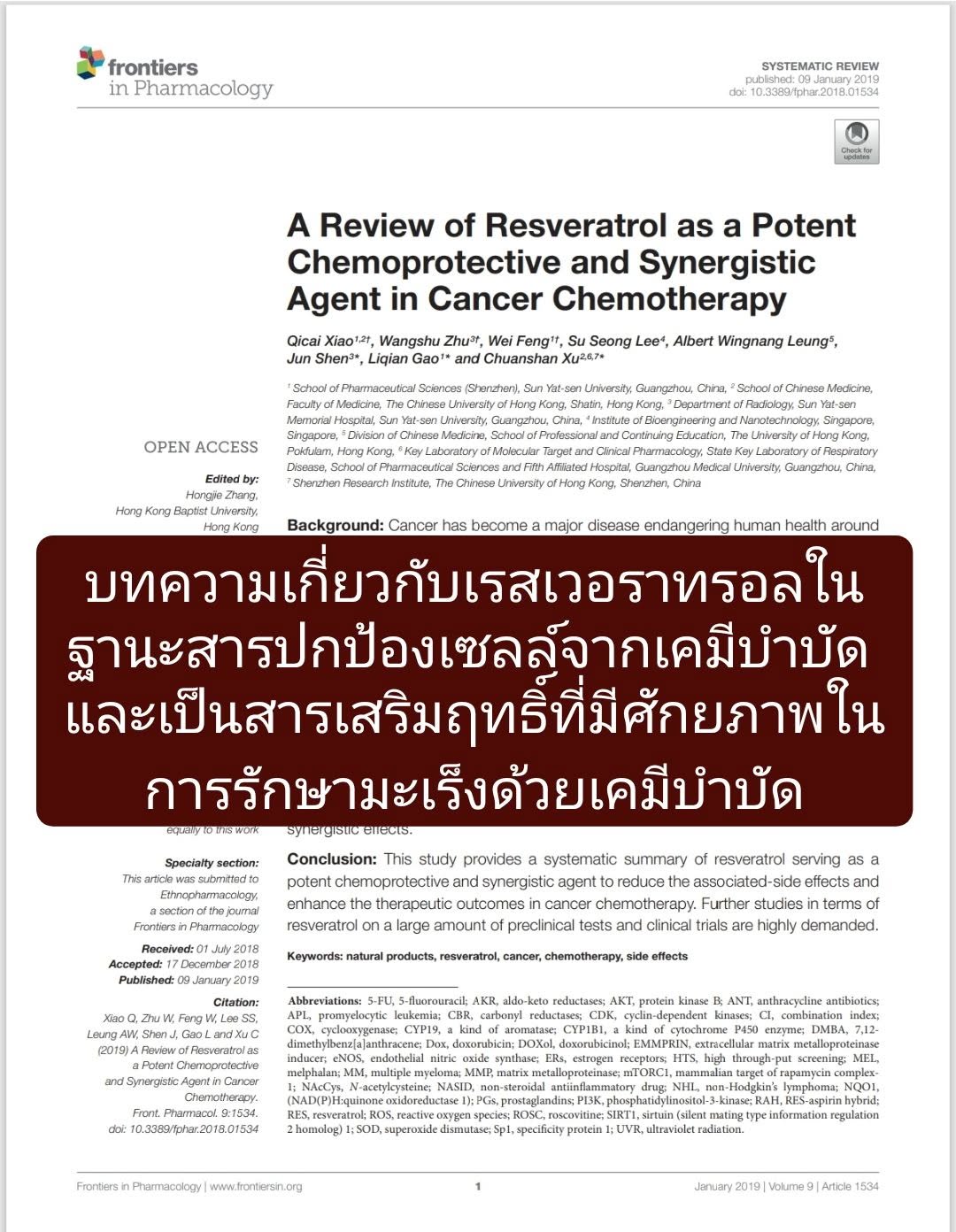
Summary of the article
A Review of Resveratrol as a Potent Chemoprotective and Synergistic Agent in Cancer Chemotherapy
(Frontiers in Pharmacology, 2019)
This article reviews research on Resveratrol, a natural polyphenol found in red grapes, mulberries, and some plants. Focusing on the role of Resveratrol in reducing side effects from chemotherapy. and helps enhance the efficiency of cancer treatment in combination with chemotherapy drugs
1. Purpose of the article
This is because cancer treatment with chemotherapy often causes severe side effects, such as
- Cardiotoxicity
- Hepatotoxicity
- Nephrotoxicity (Nephrotoxicity)
- Toxic to the digestive system
- drug resistance
- Recurrence of cancer
The researchers therefore studied whether Resveratrol can be both a "chemoprotective agent" and a "synergistic agent" in treating cancer.
2. What is Resveratrol?
Resveratrol or
3,5,4′-trihydroxy-trans-stilbene It is a natural substance that has important effects including:
+ Antioxidants (Antioxidant)
+ anti-inflammatory (Anti-inflammatory)
+ Antivirus
+ Antifungal
+ Slow down deterioration
+ Anticancer (Anticancer)
Especially the antioxidant effect Helps reduce cell damage from ROS (Reactive Oxygen Species), which is a major cause of toxicity from chemotherapy.
3. Resveratrol helps “prevent side effects” from chemotherapy.
3.1 Prevent heart toxicity
Chemotherapy drugs such as
Doxorubicin
Daunorubicin
Arsenic trioxide (As₂O₃)
often causes
Heart inflammation
Arrhythmia
heart failure
Resveratrol reduces ROS and increases SOD enzyme levels, reducing heart cell damage. And it is reported that Resveratrol is one of the most effective antioxidants.
3.2 Prevent kidney toxicity
Resveratrol helps
Reduce the accumulation of toxins from chemotherapy.
Reduce kidney damage
Helps remove toxins from the body
Thus reducing kidney damage from using chemotherapy.
3.3 Prevent liver toxicity
Resveratrol helps reduce
oxidative stress
inflammation of the liver
Liver cell damage from chemotherapy drugs
Thus reducing hepatitis from cancer treatment.
3.4 Prevent skin cancer from UV rays
Resveratrol can also help reduce skin damage from UVB and reduce the chance of skin cancer.
4. Resveratrol helps “strengthen” cancer treatment.
Resveratrol doesn't just prevent side effects. but also helps increase the efficiency of chemotherapy drugs by
Helps cancer cells become more sensitive to drugs.
Helps stimulate the death of cancer cells (Apoptosis)
Inhibits the division of cancer cells
Reduce the spread of cancer
Reduce the creation of new blood vessels in cancer tumors.
This makes chemotherapy drugs work better. and may help reduce the use of excessively high doses of the drug.
5. Important mechanism of Resveratrol
Resveratrol works through several routes, such as:
NF-κB
SIRT1
NQO1
CYP1B1
COX
IL-6
TNF-α
IL-1β
produce results
Reduce inflammation
Reduce DNA damage
Reduces the formation of estrogen-DNA adducts.
Inhibits the onset of cancer
Reduce chemotherapy resistance
Summary of the researcher
Resveratrol has great potential to be “Chemoprotective Agent”
Helps reduce side effects from chemotherapy and “Synergistic Agent”
Helps enhance the efficiency of cancer treatment
The shortest summary
“Resveratrol makes cancer treatment more effective.
and helps reduce damage from chemotherapy drugs.”
Therefore, it is a natural substance that has great potential in the future of contemporary cancer treatment.