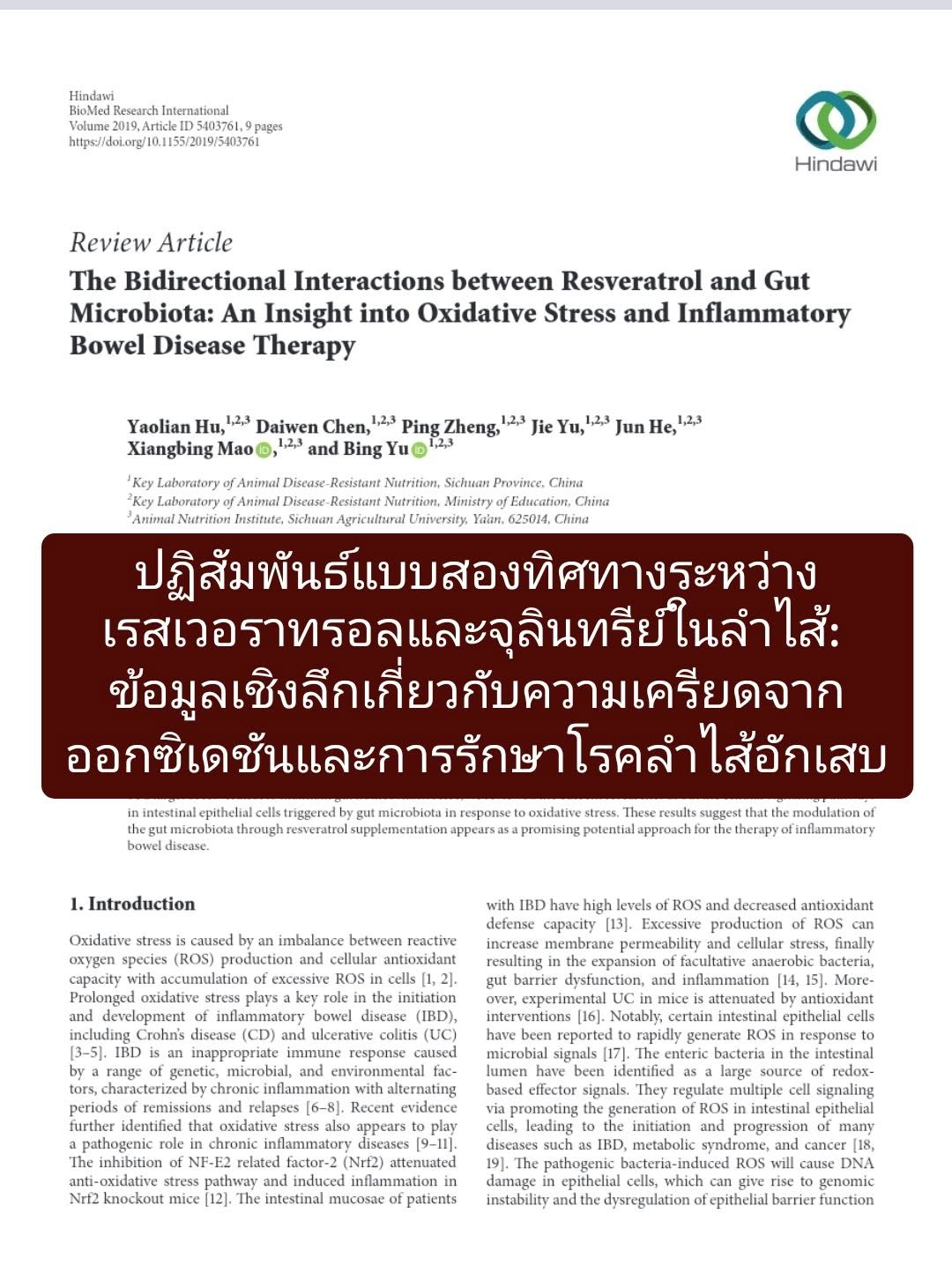
บทความ “The Bidirectional Interactions between Resveratrol and Gut Microbiota: An Insight into Oxidative Stress and I...
The article “The Bidirectional Interactions between Resveratrol and Gut Microbiota: An Insight into Oxidative Stress and Inflammatory Bowel Disease Therapy” is a review article that explains the “bidirectional interaction” between Resveratrol and Gut Microbiota, emphasizing its role in Oxidative Stress and the treatment of chronic inflammatory bowel diseases (IBD: Inflammatory Bowel Disease) such as Crohn's disease and Ulcerative colitis
Summary of the article
1. Main problem: Dysbiosis + Oxidative Stress causes chronic inflammatory bowel disease.
The researcher explains that
When the balance of microorganisms in the intestines is disrupted (Dysbiosis)
Too much Reactive Oxygen Species (ROS) will be created.
Resulting in Oxidative Stress
destroys the intestinal lining increased inflammation and stimulate the development of chronic inflammatory bowel disease
Patients with chronic inflammatory bowel disease often find that
High ROS
Low antioxidant defense system
weak intestinal lining
Increased chronic inflammation
2. Gut Microbiota affects the generation of ROS.
Some bacteria have different effects.
good bacteria
such as Lactobacillus / Lactococcus lactis
help
Maintain ROS balance at an appropriate level.
Strengthen the intestinal barrier
Reduce inflammation
Treat gut homeostasis
Bacteria cause problems
such as Enterococcus faecalis causing
Too high ROS generation
Damages the DNA of intestinal lining cells
increased inflammation
Stimulates chronic inflammatory bowel disease to be more severe
3. Resveratrol is an important substance that helps reduce problems.
Resveratrol is a polyphenol found in red grapes, Polygonum cuspidatum, and berries.
qualified
antioxidant
anti-inflammatory
antibacterial
anticancer
anti-obesity
Especially it is a strong ROS scavenger that helps eliminate free radicals well.
4. “Two-way” relationships (Bidirectional Interaction)
This is the gist of the article.
Side 1: Resveratrol → Adjusts Gut Microbiota
Resveratrol helps
Increase good bacteria
Lactobacillus
Bifidobacterium
Blautia
Dorea
Reduce bad bacteria
Enterococcus faecalis
Parabacteroides
Some types of Bacteroides
The result is
Reduce inflammation
Reduce oxidative stress
Adjust tight junction
Strengthen the gut barrier
Reduce the risk of chronic inflammatory bowel disease
Side 2: Gut Microbiota → Change resveratrol to be more effective.
Although resveratrol is poorly absorbed (poor bioavailability)
But the gut microbiota helps convert it into active metabolites such as
Dihydroresveratrol (DH-RES)
Piceid
3,4'-dihydroxy-trans-stilbene
which these substances still have effects
antioxidant
anti-inflammatory
Close to or equivalent to the original resveratrol.
5. Important mechanism for reducing inflammation
Resveratrol helps through important pathways.
Stimulate Nrf2 pathway
→ Increase antioxidant defense
Inhibits NF-κB pathway
→ Reduce inflammatory cytokines
Reduce ROS overproduction
→ Prevent epithelial damage
Protect the intestinal barrier
→ Reduce gut permeability and leaky gut.
6. Research in Ulcerative colitis patients
It is reported that
Supplementing with resveratrol helps
Reduces proinflammatory mediators
Inhibits NF-κB activity
Helps in patients with active ulcerative colitis
Researcher's conclusion
The researchers suggest that using resveratrol to modulate the gut microbiota
It is a new approach with high potential.
for treatment Chronic inflammatory bowel disease
Especially in the field
Reduce oxidative stress
Restoring the microbiome
Reduce inflammation
Prevents damage to the intestinal lining.
Brief summary
“Resveratrol Not only is it an antioxidant but also "works with the gut microbiota" to reduce ROS + reduce inflammation + restore the intestines + help treat chronic inflammatory bowel disease. Therefore, it is one of the important substances for
Gut Health + Anti-inflammatory + Healthy Aging