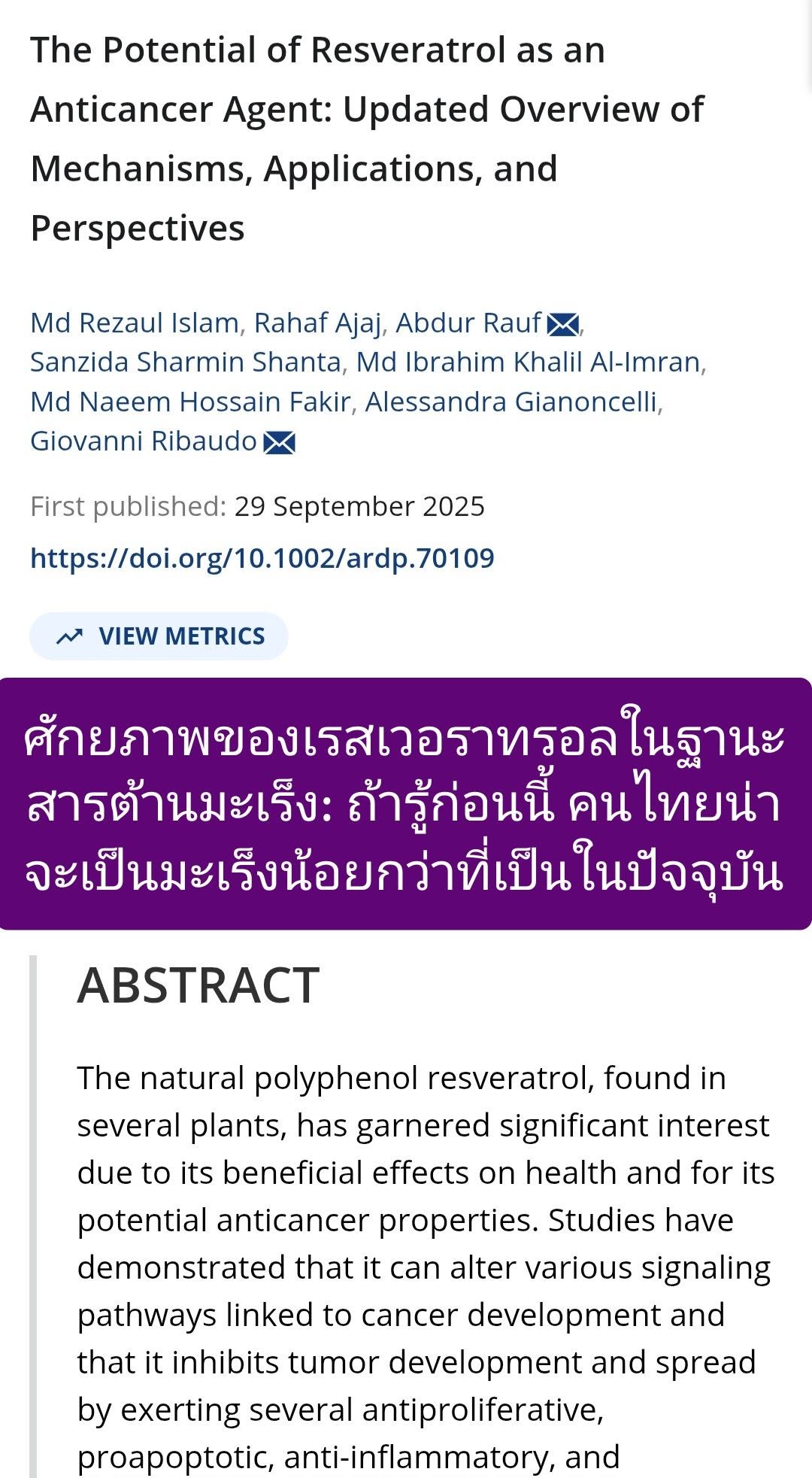
“The Potential of Resveratrol as an Anticancer Agent: Updated Overview of Mechanisms, Applications, and Perspectives”...
Summary of the article “The Potential of Resveratrol as an Anticancer Agent: Updated Overview of Mechanisms, Applications, and Perspectives” published in the journal Archiv der Pharmazie, year 2025.
The essence of the article
This article reviews the latest research on Resveratrol, a natural polyphenol found in red grapes, mulberries, and some plants. By emphasizing the potential to be Anticancer agent
The authors concluded that resveratrol Has properties that help prevent birth. growth and the spread of cancer cells through many mechanisms such as
- Inhibits the division of cancer cells (antiproliferative)
- Stimulates the death of cancer cells by means of apoptosis.
- Reduce inflammation (anti-inflammatory)
- Inhibits the creation of new blood vessels in cancer tumors. (antiangiogenic)
- Reduce oxidative stress
- Control epigenetic modifications related to cancer
Important mechanism for fighting cancer
1. Stimulate Apoptosis (death of cancer cells)
Resveratrol increases the activity of proteins that promote apoptosis, such as p53, Bax, and caspases, while decreasing proteins that help cancer cells survive, such as Bcl-2.
The result is that cancer cells undergo the natural death process more easily.
2. Inhibits cell division
Resveratrol disrupts the cell cycle, causing cancer cells to stop dividing. Especially in the G1/S and G2/M stages.
As a result, the tumor grows more slowly.
3. Anti-inflammatory
This substance reduces the function of important signaling pathways such as
NF-κB
STAT3
COX-2
TNF-α
which is related to chronic inflammation and cancer.
4. Inhibit Angiogenesis
Resveratrol reduces the production of VEGF and the signal that helps cancer form new blood vessels.
Therefore reducing the chance that the cancer will grow and spread.
5. Control Oxidative Stress and Epigenetics
Helps reduce ROS that damage DNA and also affects the expression of cancer-related genes such as DNA methylation and histone modification.
Brief summary
Resveratrol doesn't just kill cancer directly, but helps "break the cycle of cancer growth" through several mechanisms.
Therefore, it is one of the natural substances that the cancer research world is most interested in today.