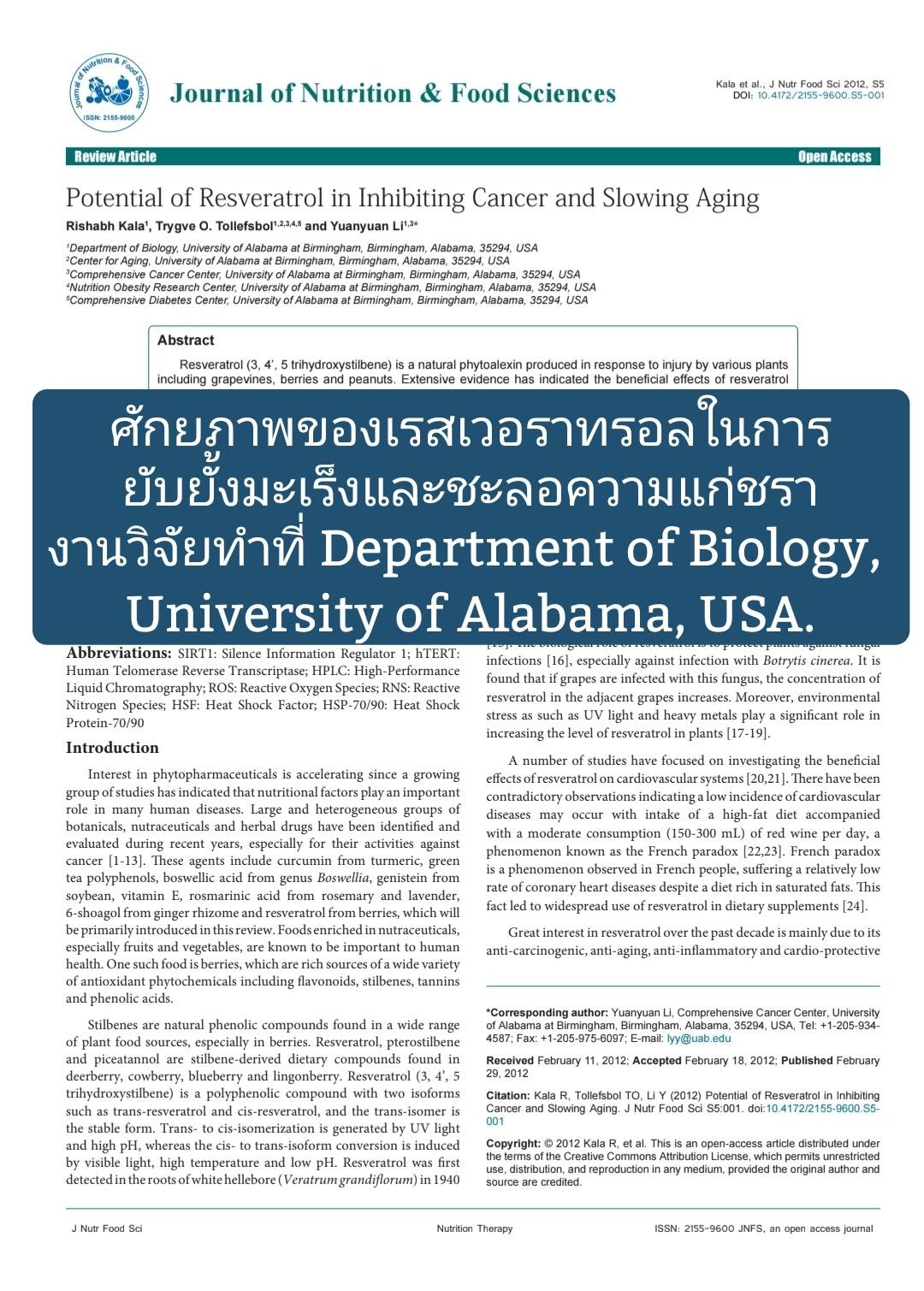
The research “Potential of Resveratrol in Inhibiting Cancer and Slowing Aging” is easy to understand and complete with important points:
Summary of the research “Potential of Resveratrol in Inhibiting Cancer and Slowing Aging” in an easy to understand manner and complete with important points:
Overview of the article
Resveratrol is a polyphenol from plants (such as red grapes and mulberries).
Features:
Anti-cancer
Delay aging
Antioxidants and inflammation
Mechanism of “anti-cancer”
Resveratrol acts at several levels in the cancer process:
1. Inhibits all stages of cancer.
Initial stage (initiation)
Promotion period
Progression
2. Stimulate the death of cancer cells (Apoptosis)
Increases the activity of p53 (cancer suppressor gene)
Reduce proteins that help cancer cells survive, such as Bcl-2.
Increase Bax → causes cancer cells to die.
3. Inhibit division and spread.
Inhibits NF-κB, AP-1 → reduces inflammation and cancer growth
Reduce angiogenesis (creation of blood vessels to feed the tumor)
Decreased metastasis (fragmentation)
4. Control gene expression (Epigenetic)
SIRT1 activation
Change histone pattern → Control genes on/off
Mechanism of "slowing down aging"
1. Antioxidants (Antioxidant)
Reduce ROS (Reactive Oxygen Species) that destroy DNA and cells.
It is the main cause of degeneration and diseases of old age.
2. Stimulate SIRT1 (Longevity gene)
Mimics the effects of calorie restriction (CR).
Helps extend cell life and reduce age-related diseases
3. Reduce chronic inflammation
Inhibiting pathways related to aging such as NF-κB
Source of Resveratrol
Found mostly in:
red grape peel
mulberry
Important limitations
Low absorption in the body (low bioavailability)
Eliminated quickly in the body
Related substances
Pterostilbene (resveratrol derivative)
Better absorption
It has anti-cancer and anti-aging potential as well.
The shortest summary
Resveratrol is a natural substance that:
“Breaking the cancer cycle” can take many steps.
“Regulating genes” and stimulating the death of cancer cells
“Slows down aging” through antioxidants and stimulating SIRT1.