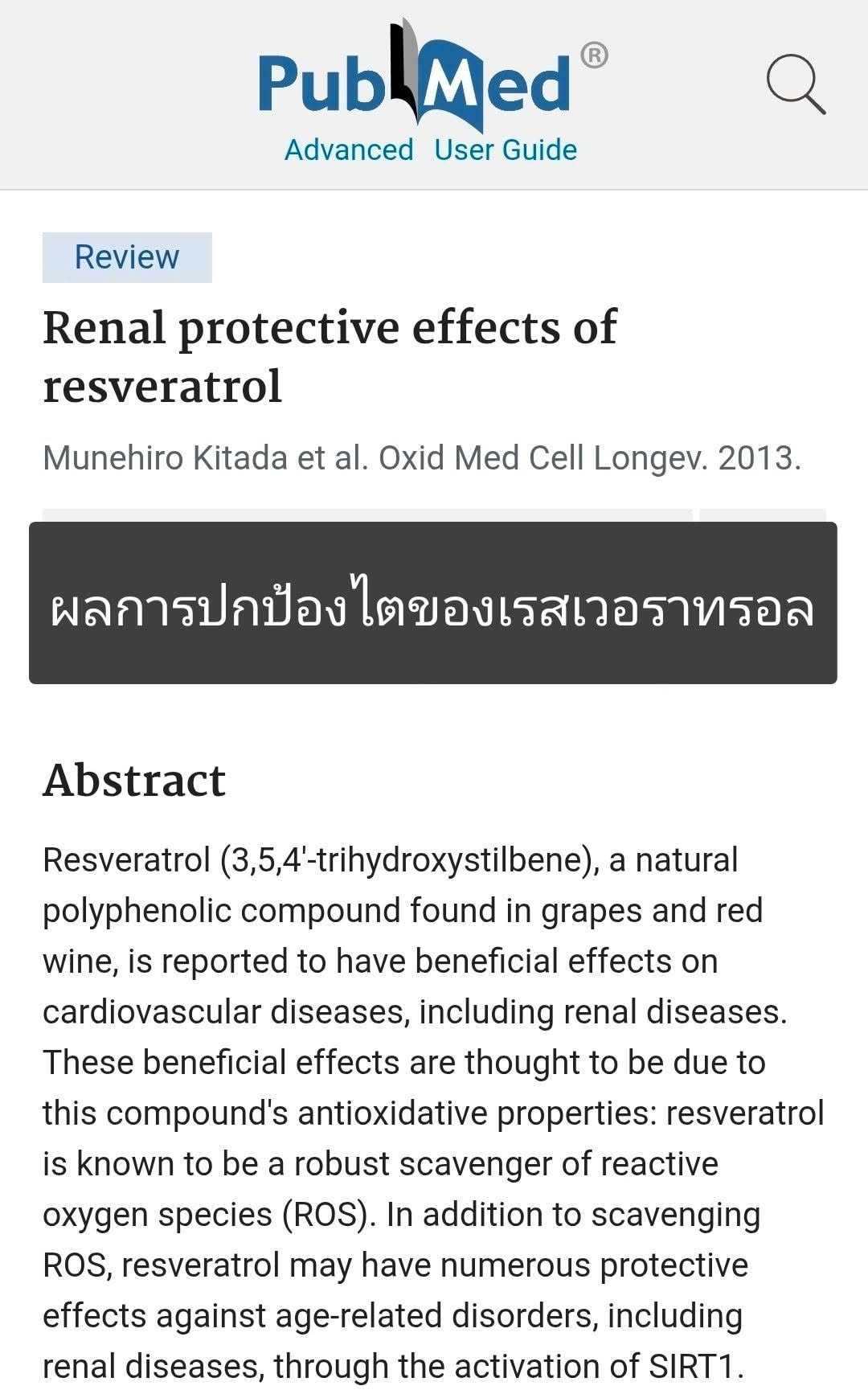
"Renal Protective Effects of Resveratrol" (Renal Protective Effects of Resveratrol)
Summary of the article "Renal Protective Effects of Resveratrol" (Renal Protective Effects of Resveratrol)
Academic article from: Oxidative Medicine and Cellular Longevity
(PMCID: PMC3863562)
1. Introduction: Importance of kidney disease and resveratrol
This article begins by pointing out the severity of Chronic kidney disease (CKD) and acute kidney injury (AKI) are major public health problems worldwide. These conditions not only lead to end-stage kidney disease (ESRD), but are also important risk factors for cardiovascular disease. which increases the death rate and reduces the quality of life At the same time, Resveratrol (Resveratrol), a polyphenol compound, (Polyphenolic phytoalexin) found naturally in many plants such as red grapes, mulberries, etc. has received a lot of attention.
This interest is partly driven by a phenomenon known as the "French Paradox," which observed that the French population has a low incidence of cardiovascular disease. Even when consuming foods that are high in saturated fat It was concluded that resveratrol in red wine was one of the key factors in this protective effect.
This article focuses on gathering evidence and describing the mechanisms by which resveratrol plays a role in Renal Protective Effects from various forms of injury.
2. The main mechanism of action of resveratrol in protecting cells The article identifies two main mechanisms by which resveratrol protects cells. (Cytoprotective effects), especially kidney cells:
2.1) Antioxidant Properties
The condition of "oxidative stress" (Oxidative Stress) is caused by an imbalance between the production of free radicals (Reactive Oxygen Species - ROS) and the body's ability to neutralize free radicals. It is an important mechanism that causes disease and deterioration of various organs, including the kidneys.
These free radicals include superoxide, hydroxyl, and peroxynitrite. It destroys proteins and DNA within cells.
Resveratrol acts as an antioxidant in 2 ways:
Direct Scavenging: Resveratrol can directly react and scavenge free radicals (ROS), preventing them from damaging cells.
Modulation of Antioxidant Enzymes: Resveratrol can modulate the expression and activity of antioxidant enzymes in the body, such as Superoxide Dismutase (SOD), Glutathione Peroxidase (GPx), and Catalase, through regulating transcription factors. (Transcription factors) such as Nrf2 and FOXO
2.2) Activation of SIRT1 protein (Activation of SIRT1)
This is the key mechanism highlighted by the article: SIRT1 (Sirtuin 1) is a NAD+-dependent deacetylase enzyme that is well known for its important role in delaying aging and extending lifespan.
SIRT1 and Calorie Restriction (CR): Numerous studies have found that calorie restriction (CR) is the only method proven to slow age-related decline and extend lifespan in many species. The key mechanism by which CR works is by "stimulating SIRT1".
Resveratrol as a "CR Mimetic": Resveratrol has been identified as a substance that can significantly stimulate SIRT1 (SIRT1 activator), making it considered a "CR Mimetic". "Calorie restriction mimetic" (CR mimetic)
Role of activated SIRT1: When SIRT1 is activated (either by CR or resveratrol), it upregulates the activity of many target proteins in the cell. It has a positive effect in many ways, including:
Anti-inflammatory (Anti-inflammation)
Resisting cell death (Anti-apoptosis)
Improving glucose/fat metabolism (Glucose/Lipid Metabolism)
Creating new mitochondria (Mitochondrial Biogenesis): Increases the efficiency of cellular energy production.
Autophagy stimulation: The process of eliminating waste or damaged cellular components.
The article noted that Resveratrol stimulates SIRT1 both directly and indirectly (e.g. through activating AMPK, the cell's energy sensor).
3. Evidence of kidney protection in study models
The article has collected evidence from "Studies showing that administration of resveratrol can alleviate or prevent kidney injury in various contexts include:
Diabetic Nephropathy: which is the main cause of chronic kidney failure.
Drug-induced kidney injury (Drug-induced Injury): such as chemotherapy or certain antibiotics.
Injuries from lack of blood supply Ischemia-Reperfusion Injury: This usually occurs after major surgery or an organ transplant.
Injuries caused by Aldosterone
Injuries related to sepsis (Sepsis-related Injury)
Unilateral Ureteral Obstruction (UUO): This is a model of Renal Fibrosis.
In these models Resveratrol has been shown to reduce kidney damage. through the antioxidant mechanisms and SIRT1 activation mentioned above.
4. Conclusion and recommendations
The article concludes that resveratrol shows strong potential to protect the kidney from a variety of acute and chronic injuries. The key mechanism is "dual mechanisms": (1) being a powerful antioxidant and (2) being a SIRT1 activator, which mimics the beneficial effects of caloric restriction.
With these features The author therefore proposes that Resveratrol is "Useful supplemental treatment" for use in preventing or slowing the progression of kidney injury in humans