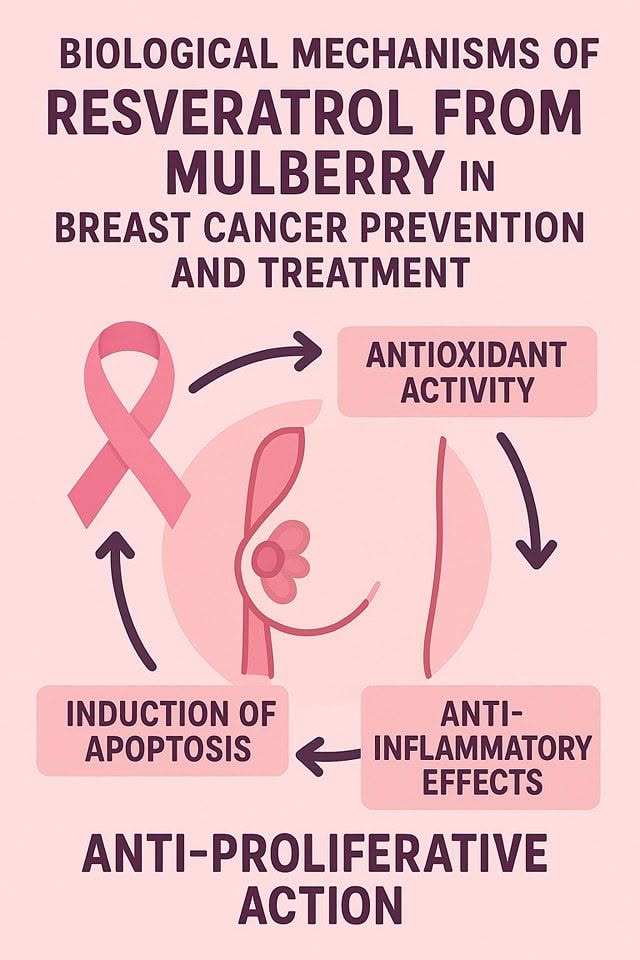
Biological mechanism of action of resveratrol extracted from mulberry in the prevention and treatment of breast cancer.
Biological mechanism of action of resveratrol extracted from mulberry in the prevention and treatment of breast cancer.
Resveratrol is a natural polyphenol compound from the stilbene family that is found in many plants, such as red grapes, peanuts, and especially mulberries (Morus spp.), which are rich sources of this compound. Numerous scientific studies over the past few decades have pointed to the potential of resveratrol to exert a wide range of biological effects. Especially in the prevention and treatment of breast cancer. Resveratrol's mechanism of action is complex and spans multiple signaling pathways within cancer cells, including:
1. Inhibition of Cell Proliferation:
Resveratrol works by interfering with the cell cycle of breast cancer cells. It can induce cell cycle disruption in the G1/S or G2/M phases, which prevents cancer cells from further dividing and multiplying. The mechanism involves regulating the expression of cell cycle regulatory proteins such as cyclin D1, CDK4/6 and p21, p27. Resveratrol can reduce the expression of proteins that promote cell division and increase the expression of proteins that inhibit cell division.
2. Induction of Apoptosis:
Apoptosis is the process of programmed cell death, which is an important mechanism for eliminating abnormal cells. including cancer cells Resveratrol can induce apoptosis in breast cancer cells through several mechanisms, including:
* Stimulation of the mitochondrial pathway Mitochondrial Pathway: Resveratrol can destabilize the mitochondria of cancer cells. This leads to the release of cytochrome c, which activates caspases such as caspase-3 and caspase-9, which are key enzymes in initiating and executing apoptosis.
* Regulation of Bcl-2 family proteins: Resveratrol can reduce the expression of anti-apoptotic proteins, such as Bcl-2 and Bcl-xL, and increase the expression of pro-apoptotic proteins, such as Bax and Bak, shifting the balance in favor of cell death.
* Stimulation of Death Receptors: Resveratrol may stimulate death receptors on the cell surface (e.g. Fas, TRAIL receptors), leading to activation of the caspase cascade and cell death.
3. Inhibition of new blood vessel formation (Anti-Angiogenesis):
creation of new blood vessels Angiogenesis is an important process necessary for growth. spread and tumor survival Cancer needs new blood vessels to carry nutrients and oxygen. Resveratrol can inhibit angiogenesis by:
* Reducing the expression of VEGF (Vascular Endothelial Growth Factor): VEGF is an important factor that stimulates the formation of new blood vessels. Resveratrol can reduce the production and secretion of VEGF from cancer cells and related cells.
* Inhibition of endothelial cell proliferation and migration: Resveratrol can inhibit the growth and migration of endothelial cells. which are the basic cells that make up new blood vessels
4. Inhibition of Metastasis and Invasion:
Spread of cancer to other organs (metastasis) is the main cause of death in breast cancer patients. Resveratrol inhibits this process by:
* Reducing the expression of enzymes involved in extracellular matrix degradation (Matrix Metalloproteinases (MMPs): MMPs are enzymes that enable cancer cells to degrade the extracellular matrix and invade nearby tissues. Resveratrol can decrease the production and activity of MMPs (such as MMP-2, MMP-9).
*Increasing E-cadherin expression: E-cadherin is a protein that functions in adhesion between cells. Loss of E-cadherin is a key feature of cancer metastasis. Resveratrol can increase the expression of E-cadherin, which helps with cell adhesion and reduces their ability to invade.
5. Anti-inflammatory effect (Anti-inflammatory effect):
Chronic inflammation is a key factor promoting the occurrence and progression of breast cancer. Resveratrol has anti-inflammatory properties by inhibiting inflammation-related signaling pathways such as NF-\kappaB (Nuclear Factor kappa-light-chain-enhancer of activated B cells), a protein that regulates the expression of genes involved in inflammation and cancer. It can also reduce the production of pro-inflammatory cytokines such as TNF-\alpha and IL-6.
6. Antioxidant effect:
Although resveratrol plays a key role in regulating cell signals, But its antioxidant properties also help prevent cancer. By eliminating harmful free radicals that can damage DNA and cells, which is one of the causes of cancer.
Summary:
Resveratrol extracted from mulberry shows interesting potential in the prevention and treatment of breast cancer through diverse and complex biological mechanisms. This includes inhibiting cell proliferation. Induction of apoptosis, inhibition of angiogenesis. spread and anti-inflammatory effects