Explain biological mechanisms Easy to understand But still maintaining scientific accuracy and avoid claiming that "Cured completely" using...
Explain biological mechanisms Easy to understand But still maintaining scientific accuracy and avoid claiming that “cured” using medically appropriate words
Deep etiological mechanism of kidney disease: The starting point lies in the degeneration of the mitochondria. (Mitochondrial Dysfunction)
The kidney is an organ that It uses a very high level of energy for the body.
This is especially true for the cells in the renal tubular cells, which require enormous amounts of ATP to filter the blood. reabsorb nutrients Expel waste and toxins
The cell's main source of ATP energy is the mitochondria.
When the mitochondria deteriorate What will happen?
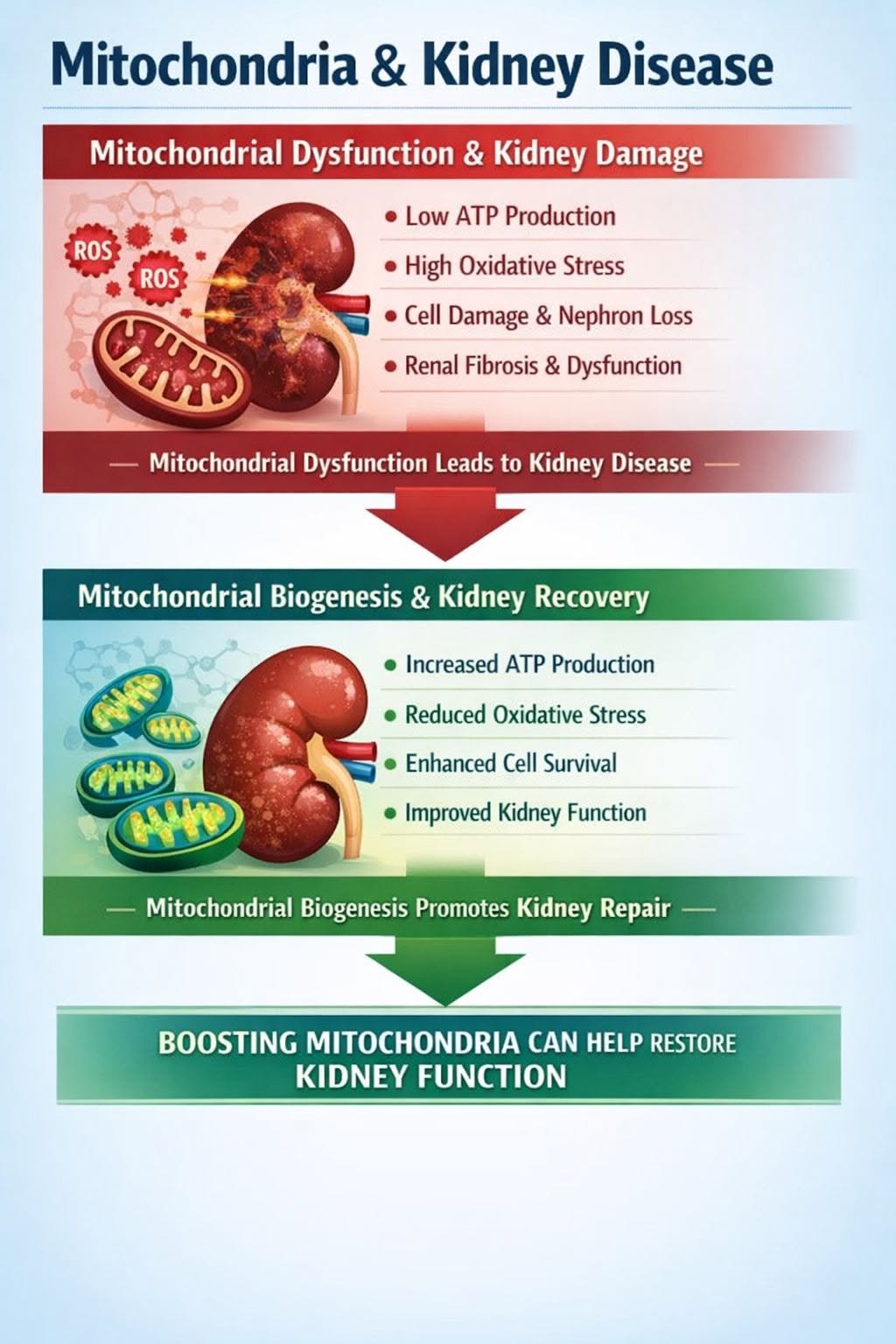
When Mitochondrial Dysfunction occurs, it leads to kidney damage in the following order:
Energy production (ATP) decreases
→ Kidney cells do not have enough energy to perform their functions.
→ Abnormal filtration and suction.
Abnormally high levels of free radicals (ROS) occur.
→ Destroys cell membranes, DNA, and proteins.
→ Stimulates chronic inflammation in the kidneys.
Kidney cell death (Apoptosis / Necrosis)
→ Kidney units (nephron) are permanently reduced.
Renal Fibrosis
→ The kidney structure is hard, deteriorated, and unable to function fully.
Modern research has found that
Chronic kidney disease (CKD), kidney deterioration from diabetes, high blood pressure, and age all have important common points. mitochondrial dysfunction
Why is “mitochondrial biogenesis” key?
Mitochondrial Biogenesis is a process in which the body
Create new mitochondria
Increases the number and efficiency of mitochondria.
Restoring the energy balance of cells
When stimulating mitochondrial biogenesis, what effects does it have on the kidneys?
Increase energy for kidney cells (ATP ↑)
→ The kidney tubular cells return to work better.
Reduce free radicals and inflammation
→ Slow down the destruction of kidney tissue.
→ Reduces fibrosis.
Prolongs the lifespan and survival of kidney cells.
→ Reduces nephron death.
Helps slow down and restore kidney function in the early to middle stages.
→ Kidney values may stabilize or improve in some cases. (depending on the stage of the disease)
Important Note
End-stage kidney disease where the kidney tissue has been permanently destroyed. It cannot be completely reversed (can slow down deterioration), but in the early to middle stages Cellular regeneration It can help slow down and improve kidney function.
Summary of the overall picture (Key Message)
Kidney disease doesn't start with the kidneys directly, but starts with "failed kidney cell energy."
And at the heart of that energy are the mitochondria.
Mitochondrial degeneration → Kidney cell failure → Kidney deterioration
Strengthens mitochondria → increases energy → reduces inflammation → slows down and restores kidney function