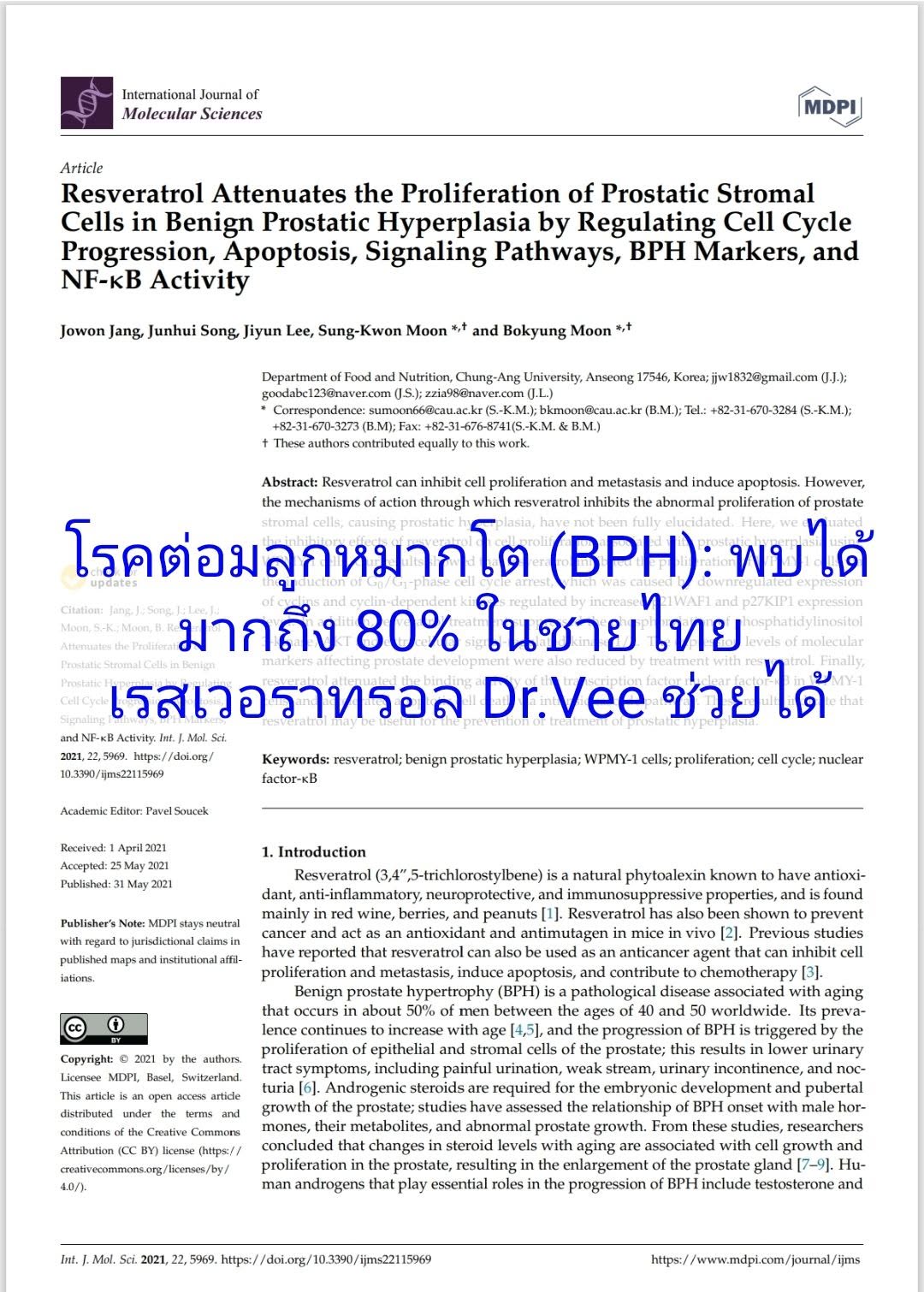
Resveratrol inhibits prostate hyperplasia (BPH) and stimulates the death of abnormal cells.
Summary of the article Resveratrol inhibits the growth of prostatic hyperplasia (BPH) cells and stimulates the death of abnormal cells.
Resveratrol Attenuates the Proliferation of Prostatic Stromal Cells in Benign Prostatic Hyperplasia by Regulating Cell Cycle
Progression, Apoptosis, Signaling Pathways, BPH Markers, and NF-κB Activity
This research studies that Resveratrol (Resveratrol)
which is found in red grapes and mulberries
What effect does it have on Tissue cells (stromal cells) of people with
Benign Prostatic Hyperplasia (BPH)
The researchers used human prostate cells in the lab as a model.
Research results found (simple explanation)
Resveratrol helps “Slow down cell growth”
Prostate cells treated with resveratrol divide more slowly.
The more you use it in large quantities. The more clearly it inhibits cell growth.
It means that it reduces the enlargement of the prostate gland.
Stop abnormal cell division
Cells normally go through several steps before dividing.
Resveratrol makes cells Stopped during the break (before division)
Unable to increase the number further.
It is like “pressing the stop button” on prostate enlargement.
Reduce hormones and substances that stimulate the enlarged prostate.
Resveratrol reduces important substances associated with BPH, such as
An enzyme that converts testosterone to stimulate the prostate.
testosterone receptor
Tissue growth stimulant
Reducing the signals that accelerate prostate enlargement.
Stimulates abnormal cells to die themselves (Apoptosis)
Resveratrol helps turn on the process. “Natural cell death”
Reduce proteins that help cells survive
Add proteins that cause cell death
Abnormal cells do not accumulate or continue to grow.
Reduce inflammation and danger signals in cells
Resveratrol inhibits NF-κB, which is a regulator of inflammation and cell survival.
When NF-κB is reduced → inflammation and abnormal growth are reduced.
Summarized as easily as possible.
Resveratrol helps in those with enlarged prostate by
Reduces the division of prostate cells.
Slow down the expansion of tissues.
Reduces the effects of hormones that stimulate BPH.
Stimulates abnormal cells to die naturally
Reduce inflammation at the cellular level
Therefore has the potential to Helps prevent or delay prostate enlargement.