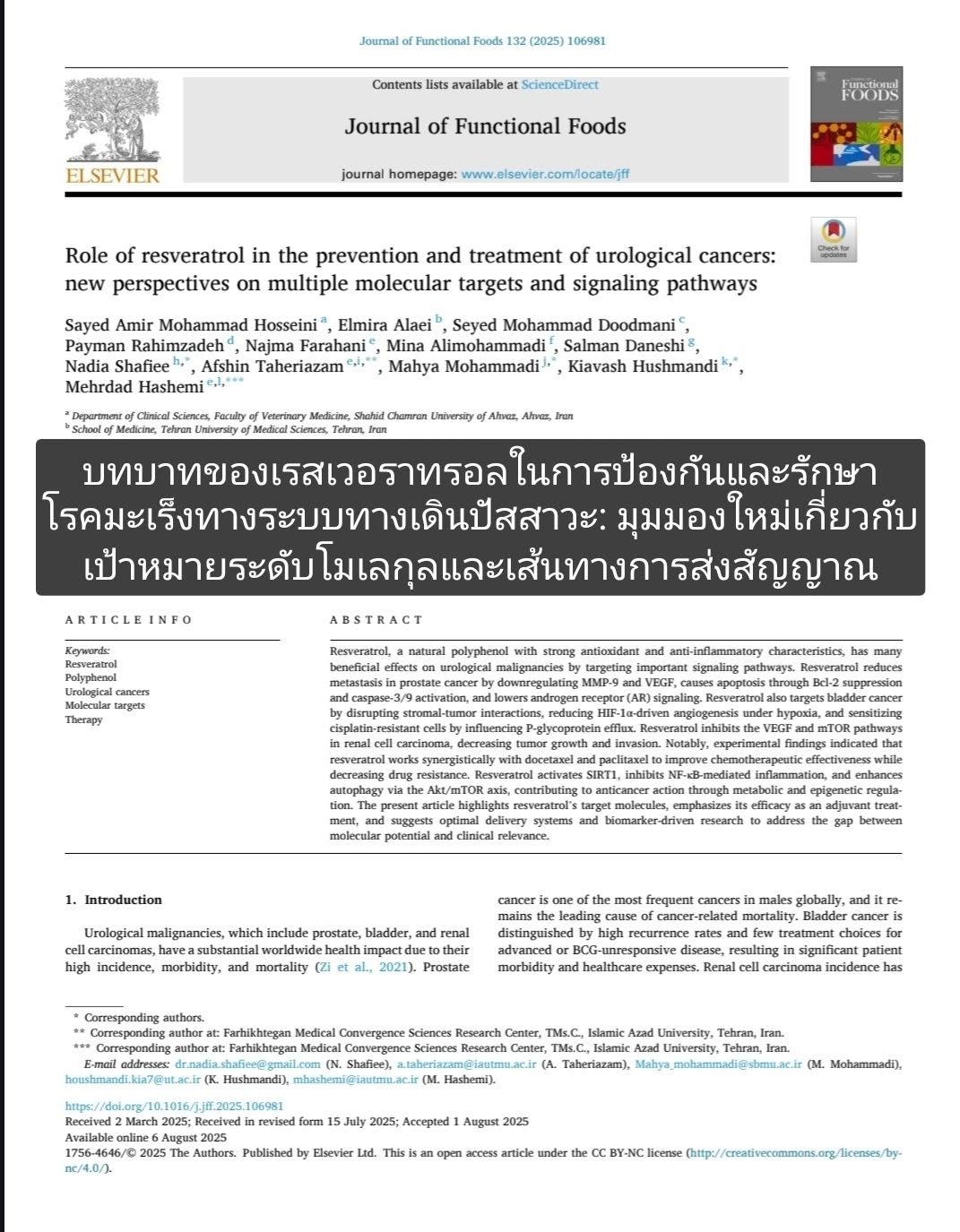
From ScienceDirect: “Role of resveratrol in the prevention and treatment of urological cancers: new perspectives...
Summary of articles from ScienceDirect's "Role of resveratrol in the prevention and treatment of urological cancers: new perspectives on multiple molecular targets and signaling pathways" in an easy-to-read format and easy to understand key points.
Article overview
This article reviews the role of resveratrol — a plant polyphenol with antioxidant and anti-inflammatory properties — in prevention and treatment. “urinary tract cancers” or urological cancers such as prostate cancer, kidney cancer (renal cell carcinoma), and bladder cancer (bladder) with a focus on related molecules and intracellular signals.
Important mechanisms of action of resveratrol
1. Resists cell growth and proliferation
Reduced MMP-2/MMP-9 expression associated with extracellular matrix destruction → Reduced cancer cell proliferation.
Inhibits VEGF/angiogenesis, which is required to form blood vessels to feed cancer tumors.
2. Stimulate cell death (Apoptosis)
Reduced signaling of proteins that help cells survive, such as Bcl-2
Increases the activity of caspase-3/-9 → cancer cells enter More "death programs"
3. Customize signal paths (Signaling Pathways)
Prostate Cancer
Inhibits PI3K/Akt/mTOR which stimulates cell growth
Reduce signaling through the Androgen receptor (AR) → Helps slow down the growth of prostate cancer.
Renal Cancer
Inhibits Akt/ERK1/2 that promotes tumor growth
Increase ROS and caspase activity to induce apoptosis.
Inhibits inflammasomes → reduces inflammation that promotes tumors
Bladder Cancer
Reduces miR-21 → reduces cell survival signals
Inhibits PI3K/Akt/mTOR → increases apoptosis and reduces cell proliferation.
4. Increase the effectiveness of chemotherapy
Resveratrol can:
cause cancer cells Respond better to chemotherapy, reduce drug resistance (chemoresistance), works with drugs such as docetaxel, paclitaxel to make treatment more effective