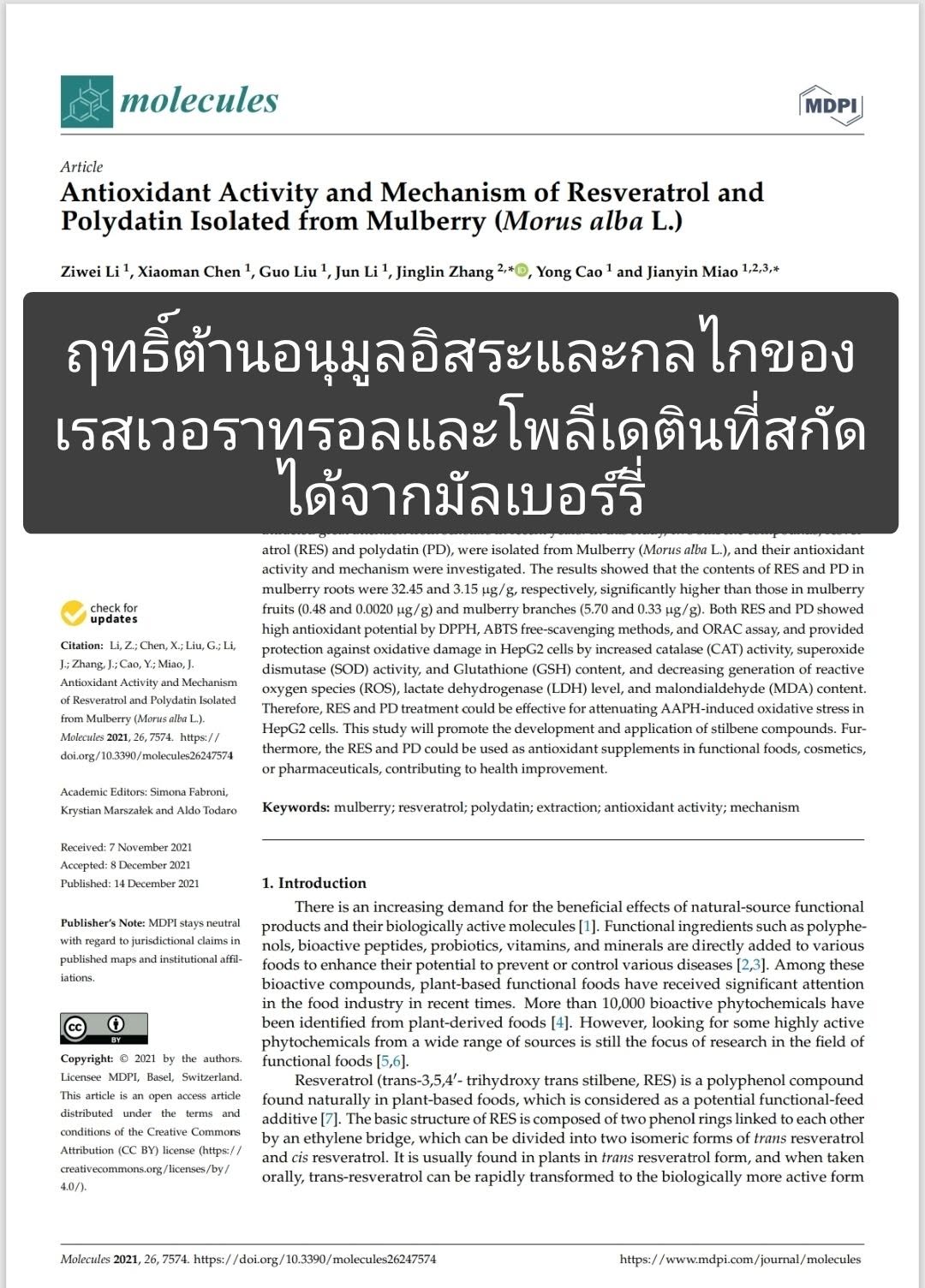
This is the Thai version of the article Antioxidant Activity and Mechanism of Resveratrol and Polydatin Isolated from Mulberry (Morus al...
Summary in Thai of the article Antioxidant Activity and Mechanism of Resveratrol and Polydatin Isolated from Mulberry (Morus alba L.) — with important points and important observations.
General information about the research
This work isolated two substances from Morus alba (mulberry) plants — Resveratrol (RES) and Polydatin (PD) — and assessed their antioxidant activity. (antioxidant) and the mechanism of action of both substances at the molecular / cellular level
The evaluation used both chemical (in vitro radical-scavenging assays) and cellular antioxidant assays to reveal both general antioxidant potential. and protecting cells under oxidative stress.
Results — How do RES & PD have antioxidant effects?
• Radical-scavenging test.
Both RES and PD were able to clearly “absorb/scavenge” free radicals in DPPH and ABTS assays — with RES having stronger activity than PD at the same concentration.
In the ORAC assay (which mimics biological oxidation conditions in the body) — both compounds showed good activity, with RES having a slightly higher ORAC value than PD.
• Protecting cells from oxidative stress (cellular antioxidant activity).
When using HepG2 human liver cells and subjecting them to oxidative stress with AAPH, pre-treating cells with RES or PD before causing oxidative stress increased cell viability in a dose-dependent manner.
Both substances reduce the production of reactive oxygen species (ROS) within cells and reduce indicators of oxidative damage such as reduced MDA (malondialdehyde) and reduced LDH (lactate dehydrogenase), which are signs of membrane/membrane damage.
In addition, RES and PD increase the activity of intracellular antioxidant enzymes SOD (superoxide dismutase) and CAT (catalase) and increase the amount of intracellular antioxidants such as GSH (glutathione) — an important mechanism that protects cells from oxidative stress.
Antioxidant mechanisms of RES & PD (according to the article)
RES will act by Free radicals “donate electrons or protons,” creating a stable phenoxy radical — which stops the reaction. chain-radical (according to ABTS assay)
In cells, RES and PD not only “capture/scavenge” free radicals directly — they also stimulate intracellular oxidative defense pathways (up-regulate antioxidant enzymes and increase GSH) — which reduce ROS, MDA, LDH and preserve cellular integrity during oxidative stress.
Simply put: RES and PD are both chemical scavenger antioxidants and biological regulators — making them highly potent both at the molecular level and in actual cells.
Observations & Limitations
Although RES has a stronger direct anti-oxidant effect than PD at the same concentration — PD has an advantage in terms of Stability and bioavailability (bioavailability) (as the author states in the introduction) — which makes PD more useful in functional food/health applications in some cases
Conclusion — “Why is this work valuable?”
This work confirms that Mulberry It is a natural source of stilbene — RES and PD — which have clear antioxidant properties both chemical and biological/regulatory.
Both substances, especially PD, have the potential to be developed as “Natural antioxidants” for use in functional food, health supplements, cosmetics or pharmaceutical applications — because they have two properties: they directly eliminate free radicals and strengthen the oxidative defense system in cells.
The information from the article helps provide a clear understanding of the “mechanism” — not just the substance. “Can resist oxidation” but points out “how” (through enzyme, GSH, reducing ROS/MDA/LDH) — which is valuable in designing health supplements/dietary supplements/herbal products.