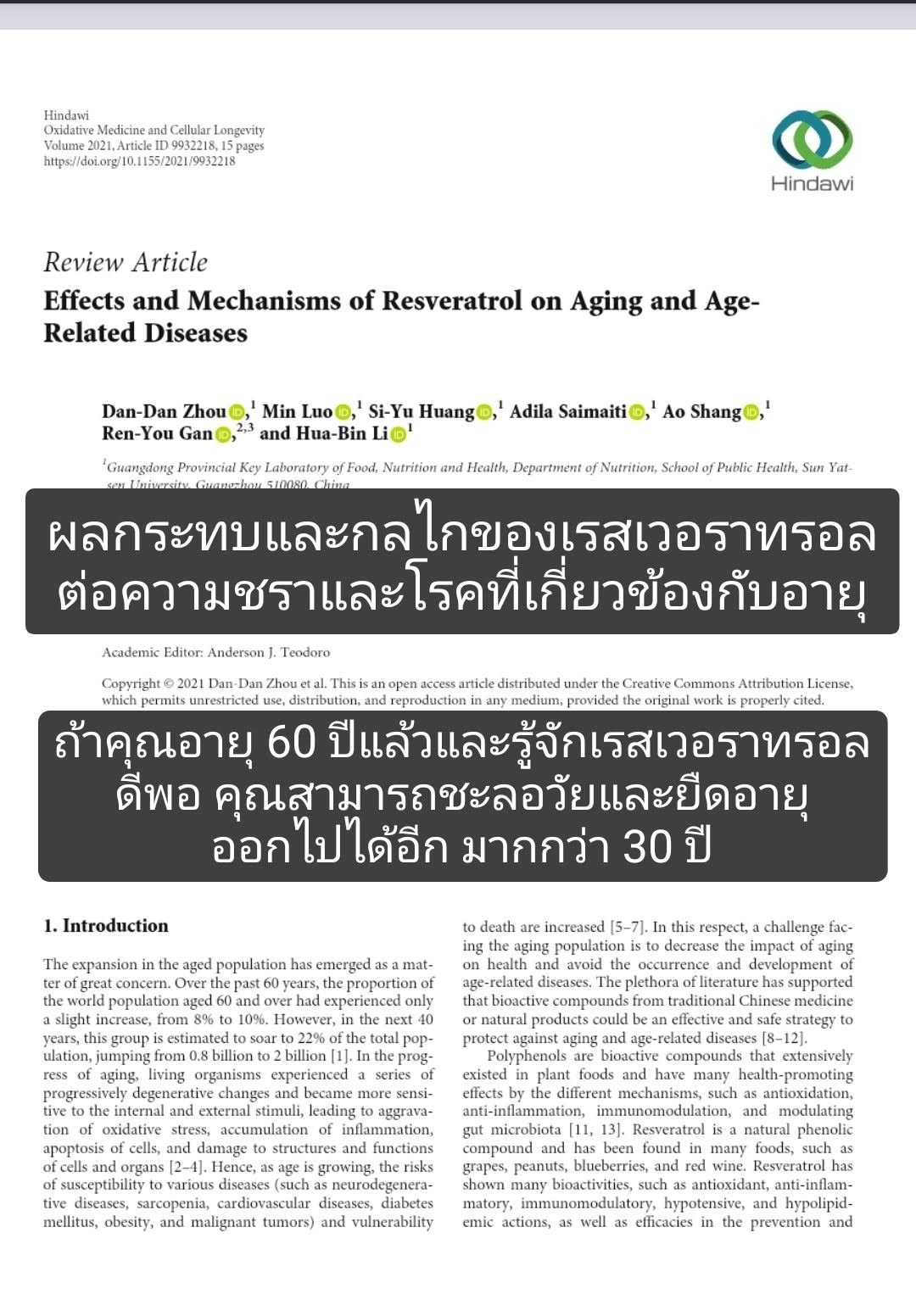
Effects and Mechanisms of Resveratrol on Aging and Age-Related Diseases (2021) — with main points, results — emphasis for...
Summary of the article Effects and Mechanisms of Resveratrol on Aging and Age-Related Diseases (2021) — with main points and results — focused on health lovers / elderly people who can apply it to the product. “Resveratrol Extracted from mulberry.”
Article overview:
This article is a “review” article collecting research on resveratrol. (Resveratrol) — found in red grapes, mulberries, etc. — that resveratrol has the potential to both delay aging/prolong life (life-extension) and prevent/alleviate age-related diseases such as brain disease, heart/vascular disease, cancer, bone/muscle disease, etc.
The article focuses on explaining the possible mechanisms by which resveratrol works — such as antioxidants. (antioxidant), anti-inflammatory (anti-inflammatory), improves mitochondrial function (mitochondrial function), control cell death (apoptosis), stimulate autophagy, etc.
Main results — Effects of resveratrol
• Life extension / aging.
Research has shown that resveratrol can increase “lifespan” — through mechanisms such as stimulating autophagy (removal of dead cells/organelles), reducing ROS and providing neuroprotection. (neuroprotection)
• Reduce the risk/alleviate age-related diseases.
The article summarizes results from many areas of research, such as:
Diseases / Problems Effects of Resveratrol / Important Mechanisms
Brain diseases / neurodegenerative diseases (such as memory loss) increases neurogenesis (building new nerve cells), reduces inflammation, reduces oxidative stress, and protects neurons. and improve memory/brain function
Heart disease / vascular system & heart Improves the function of the lining of blood vessels, increases NO (nitric oxide) production, reduces inflammation and oxidative stress, reduces cardiac remodeling in the elderly.
Muscular dystrophy (sarcopenia) Increases muscle mass, increases strength, and improves performance when combined with exercise — through modulation of mitochondrial function, anti-apoptosis, and activation of Sirt1/AMPK.
Cancer inhibits proliferation of cancer cells, stimulates apoptosis (cells die), reduces metastasis by adjusting many pathways such as NF-κB, Akt/GSK-3β/Snail, reduces EMT (epithelial–mesenchymal transition), etc.
Bone condition/osteoporosis Increases bone density, promotes new bone formation through osteoblasts.
Fertility / Ovarian conditions (ovarian aging / infertility) Research has found that Resveratrol helps maintain egg quality, increases the chance of fertilization, and reduces oxidative stress and apoptosis in reproductive cells.
In conclusion, resveratrol has “multi-faceted” potential to help us not only “live longer” but “live well” — reducing the risk of many chronic diseases that often accompany aging.
Mechanisms by which resveratrol works (Mechanisms)
The article outlines the main mechanisms that explain why. Resveratrol has effects on slowing down aging and preventing degenerative diseases, including:
Anti-oxidation (Antioxidant): resveratrol stimulates the anti-ROS system in cells, such as increasing antioxidant enzymes (SOD, CAT), stimulating Nrf2 — reducing lipid peroxidation and damage to proteins/cells.
Inhibits inflammation (Anti-inflammation): Reduces inflammatory substances (such as IL-1β, TNF-α, MCP-1) and inhibits the NF-κB pathway — which reduces “inflammaging” (chronic inflammation that comes with aging).
Improves Mitochondrial Function & Cellular Energy: resveratrol stimulates the creation of new mitochondria. (mitochondrial biogenesis), increases mtDNA copy number, increases ATP production and promotes autophagy — helping cells to have good energy. Reduce organ deterioration
Regulation of apoptosis / autophagy: through stimulating Sirt1, inhibiting p53, balancing apoptosis proteins (e.g. Bcl, Bax, Bim) and stimulating autophagy — helping to eliminate degenerated/damaged cells. Reduce the risk of cancer & tissue degeneration
These mechanisms often work together — resisting oxidative stress + reducing inflammation + adjusting cell energy + cleaning old cells = prolonging life and reducing diseases that come with age.
Conclusions & practical ideas
Resveratrol is a natural nutrient that has been heavily researched — showing “high potential” to delay aging and reduce age-related diseases — through several mechanisms. (antioxidant, anti-inflammatory, modulates cell energy, controls apoptosis/autophagy)
For the product you are thinking about, such as “Resveratrol Extracted from Mulberry” — this article provides There is a “strong scientific basis” to support that consuming foods/products containing resveratrol helps with long-term health.