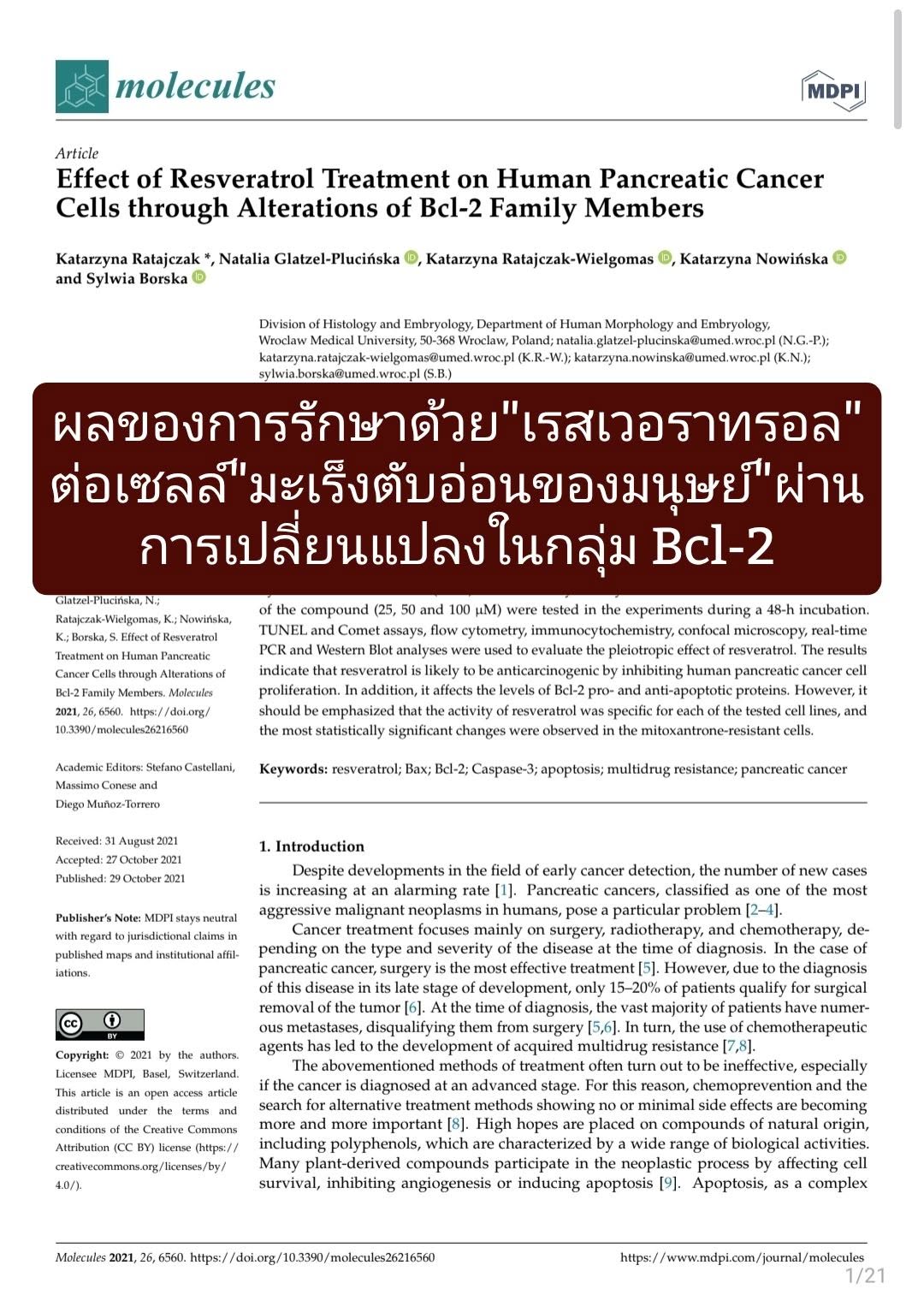
“Effect of Resveratrol Treatment on Human Pancreatic Cancer Cells through Alterations of Bcl-2 Family Members” ศึกษาผ...
Summary of the article “Effect of Resveratrol Treatment on Human Pancreatic Cancer Cells through Alterations of Bcl-2 Family Members” studies the effects of resveratrol. (Resveratrol) on human pancreatic cancer cells Emphasis is placed on the mechanism of stimulating cell death (Apoptosis) through changes in proteins in the Bcl-2 family.
The essence of the research
Educational objectives
Researchers want to see if “Resveratrol” which is a polyphenol substance found in abundance in red grapes and mulberries.
The essence of the research
Educational objectives can be:
● Inhibits the growth of pancreatic cancer cells.
● Stimulates the death of cancer cells.
● Changes in the activity of apoptosis-regulating proteins such as Bcl-2 and Bax.
Is it possible?
Experimental method
Use 4 types of cells:
- General pancreatic cancer cells
- Pancreatic cancer cells are resistant to chemotherapy.
- Cancer cells AsPC-1
- Normal pancreatic cells (H6c7)
Resveratrol was then administered at concentrations of 25, 50, and 100 µM for 48 hours and examined:
■ Cell survival.
■ Cell cycle
■ DNA damage
■ Expression of Bcl-2, Bax, and Caspase-3 proteins.
Important research results
1. Resveratrol inhibits the growth of cancer cells.
☆ The number of pancreatic cancer cells decreased according to:
- Resveratrol concentration
- duration of exposure
Especially cells that are resistant to chemotherapy. Instead, they responded very well to resveratrol.
2. Stimulate the death of cancer cells (Apoptosis)
Resveratrol has been found to cause:
- Bcl-2 protein (anti-apoptosis) decreased.
- Bax and Caspase-3 proteins (stimulate cell death) increased.
In short, it causes cancer cells to enter the natural process of "killing themselves".
3. Has less effect on normal cells
Although resveratrol has some effect on normal cells, But the effects were more pronounced on cancer cells. Therefore, it is likely to be safer than some types of chemotherapy.
4. May help solve the problem of "drug resistance"
Research has shown that cancer cells that are resistant to mitoxantrone also respond well to resveratrol. Therefore it is possible that:
- Resveratrol may be used in combination with chemotherapy.
- Helps reduce drug resistance
Researcher's conclusion
Resveratrol has potential as an anti-pancreatic cancer agent because it can:
• Reduce the division of cancer cells.
• Stimulates apoptosis.
• Change in Bcl-2/Bax protein balance.
• Helps reduce chemotherapy resistance.
Brief summary
“Resveratrol” can stop pancreatic cancer cells from growing and induce cancer cell death by reducing Bcl-2 and increasing Bax/Caspase-3. Therefore, it is a natural substance that has the potential to help treat or enhance the treatment of pancreatic cancer.