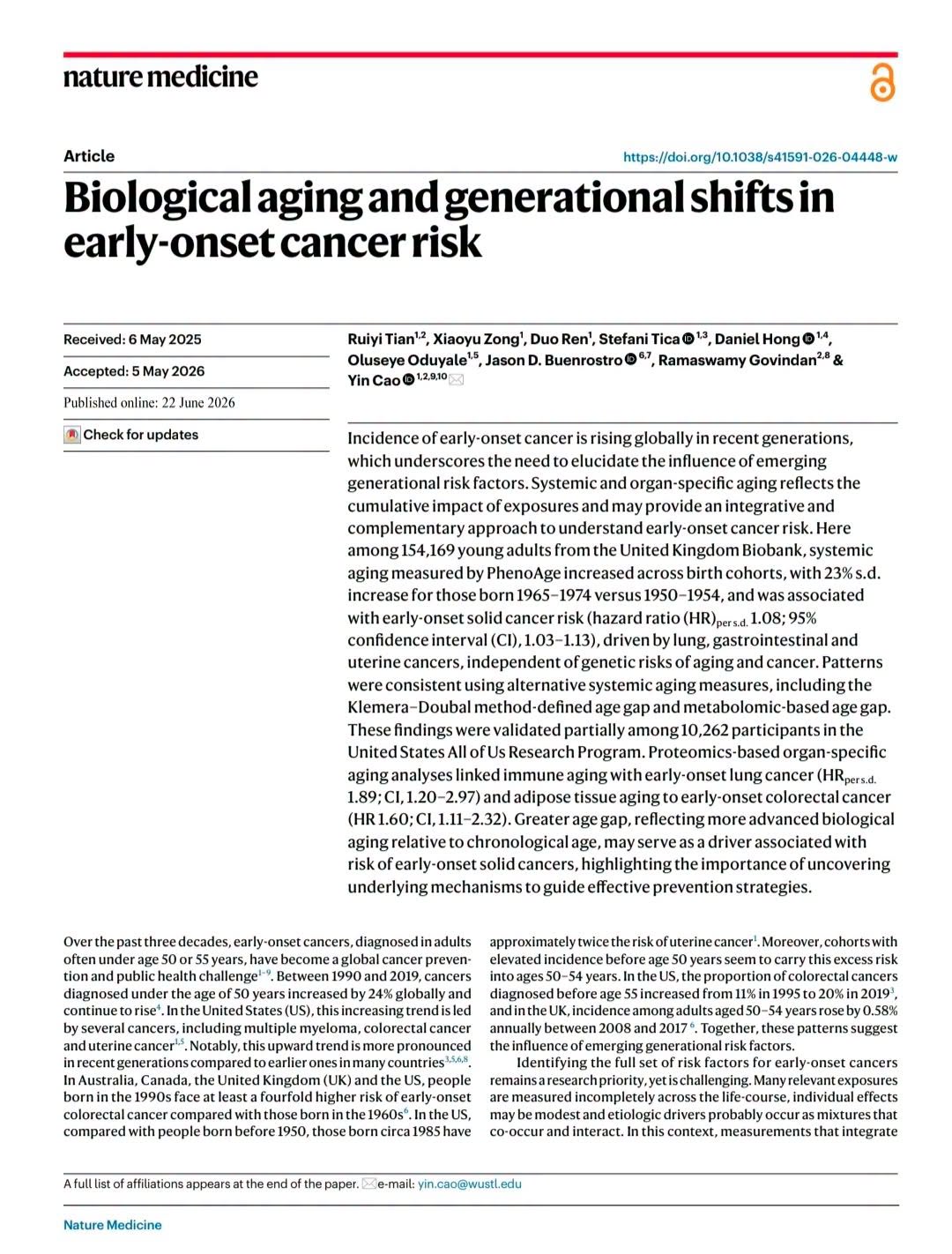
“Biological aging and generational shifts in early-onset cancer risk” was published in the journal Nature Medicine in June...
Summary of the article “Biological aging and generational shifts in early-onset cancer risk,” published in the journal Nature Medicine in June 2026, studies the relationship between "Biological Age" and the risk of early-onset cancer, using data from more than 154,000 people in the UK Biobank and more than 10,000 people in the All of Us project in the US.
Essence
1. The new generation has a "biological age" that ages faster.
The researchers found that people born between 1965 and 1974 had a PhenoAge that was approximately 23% higher than people born between 1950 and 1954, even though their actual ages were similar. It shows that the body of the new generation looks like "aging faster" in biology
2. Biological age that is older than actual age Increased cancer risk in young adulthood
When comparing people with a biological age higher than their actual age, it was found that for every 1 standard deviation increase in the Age Gap value
The risk of cancer occurring before age 55 increases by approximately 8%.
3. Not explained by genetics alone
Although the researchers adjusted the results accordingly.
Genetics related to aging Genetics that increase cancer risk, telomere length
The relationship between biological aging and cancer remains. This indicates that environmental and lifestyle factors likely play an important role.
4. Aging of some organ systems is related to specific types of cancer.
Blood protein analysis found
Aging immune system → associated with lung cancer
Aging adipose tissue → associated with colon cancer
It shows that "organ-specific aging" plays a different role in the development of each type of cancer.
Why is this work important?
Over the past 30 years, cancers in people under 50 have increased worldwide by about 24%, but the medical community still doesn't know all the causes. This research suggests that
> "Biological aging occurs faster in the new generation. It is one of the mechanisms that explains the increase in cancers at younger ages.”
Brief summary
The new generation has a tendency They "biologically age" faster than previous generations. And people who are actually biologically older are at risk of developing premature cancer. In particular, lung, colon and uterine cancers are on the rise. Research indicates that "Slowing down the aging of the body" is an important way to prevent modern cancers in the future.
This research falls squarely on Resveratrol Dr. Vee.