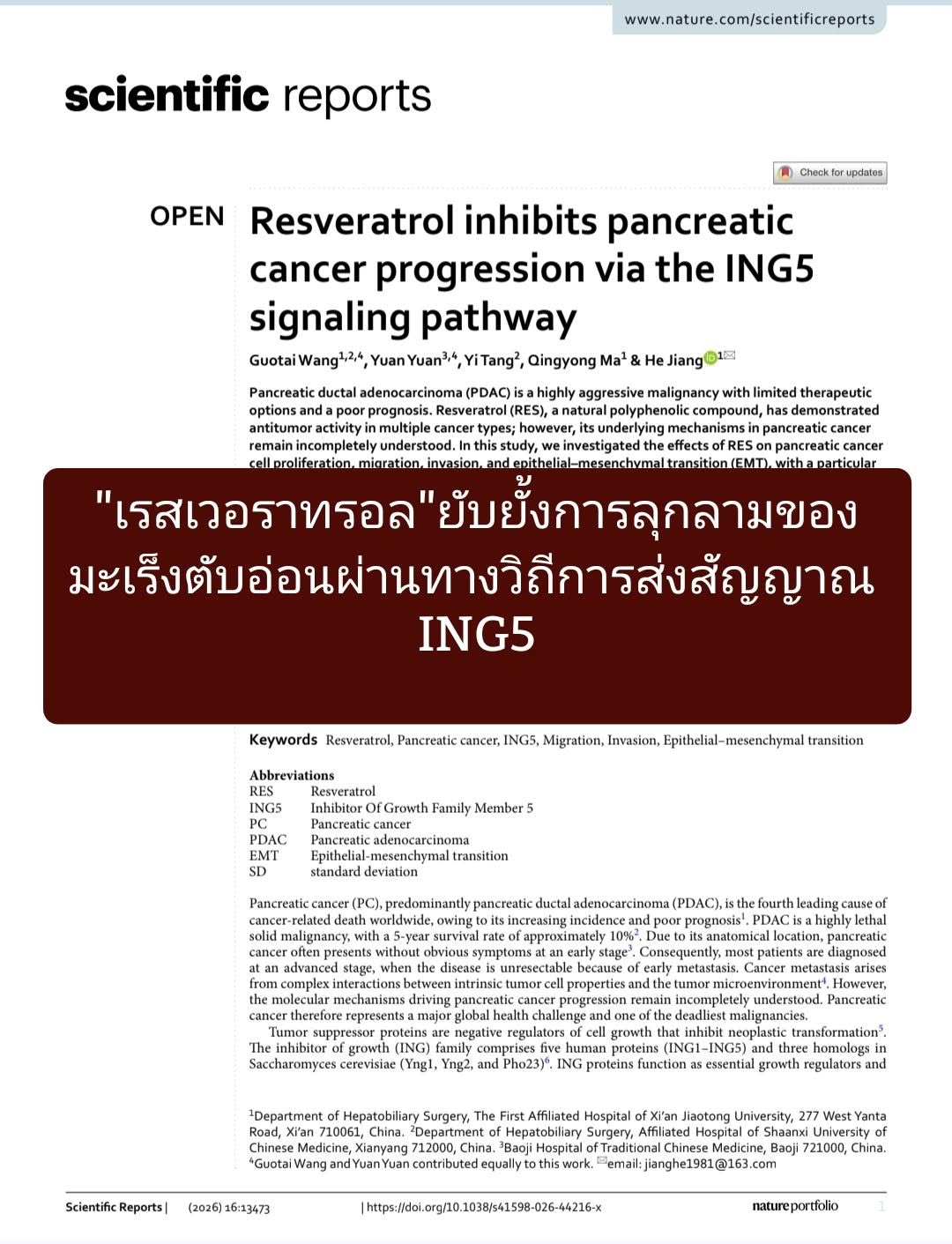
From the journal Scientific Reports, studying the effect of Resveratrol on pancreatic cancer, PDAC (Pancreatic Ductal Adenocarcinoma),...
Summary of the article from the journal Scientific Reports, studying the effect of Resveratrol on pancreatic cancer PDAC (Pancreatic Ductal Adenocarcinoma), which is a severe cancer with a low survival rate. Researchers found that resveratrol can inhibit the progression of cancer cells through stimulating a protein called ING5.
Summary of important points
1. Resveratrol helps inhibit the growth of pancreatic cancer cells.
Researchers tested pancreatic cancer cell lines PANC1 and SW1990 and found that when resveratrol was given:
● The division of cancer cells is reduced.
● Reduced colony formation of cancer cells.
● The ability to spread and invade tissue is reduced.
2. Resveratrol inhibits the EMT process.
EMT (Epithelial–Mesenchymal Transition) is a process that makes it easier for cancer cells to spread.
Research has found that Resveratrol:
■ Increases E-cadherin protein levels (helps cells stick together reduce spread)
■ Reduces N-cadherin levels (related to cancer progression).
Thus reducing the ability of pancreatic cancer to spread.
3. ING5 protein is key
ING5 is a protein that acts like a “tumor suppressor” or cancer suppressing protein.
Research has found that:
☆ Resveratrol increases ING5 levels.
☆ When ING5 was disabled with siRNA, cancer cells grew back and spread more.
☆ Resveratrol's anticancer effect was markedly reduced when ING5 was inhibited.
In summary, ING5 is an important mediator that causes Resveratrol to have anti-cancer effects.
Conclusion of the research
The researchers concluded that Resveratrol:
Helps inhibit the growth, invasion, and spread of pancreatic cancer.
It works through increasing the expression of ING5.
It's a new way to develop pancreatic cancer drugs.
This is considered mechanistic evidence supporting the potential of Resveratrol in the anti-cancer field.