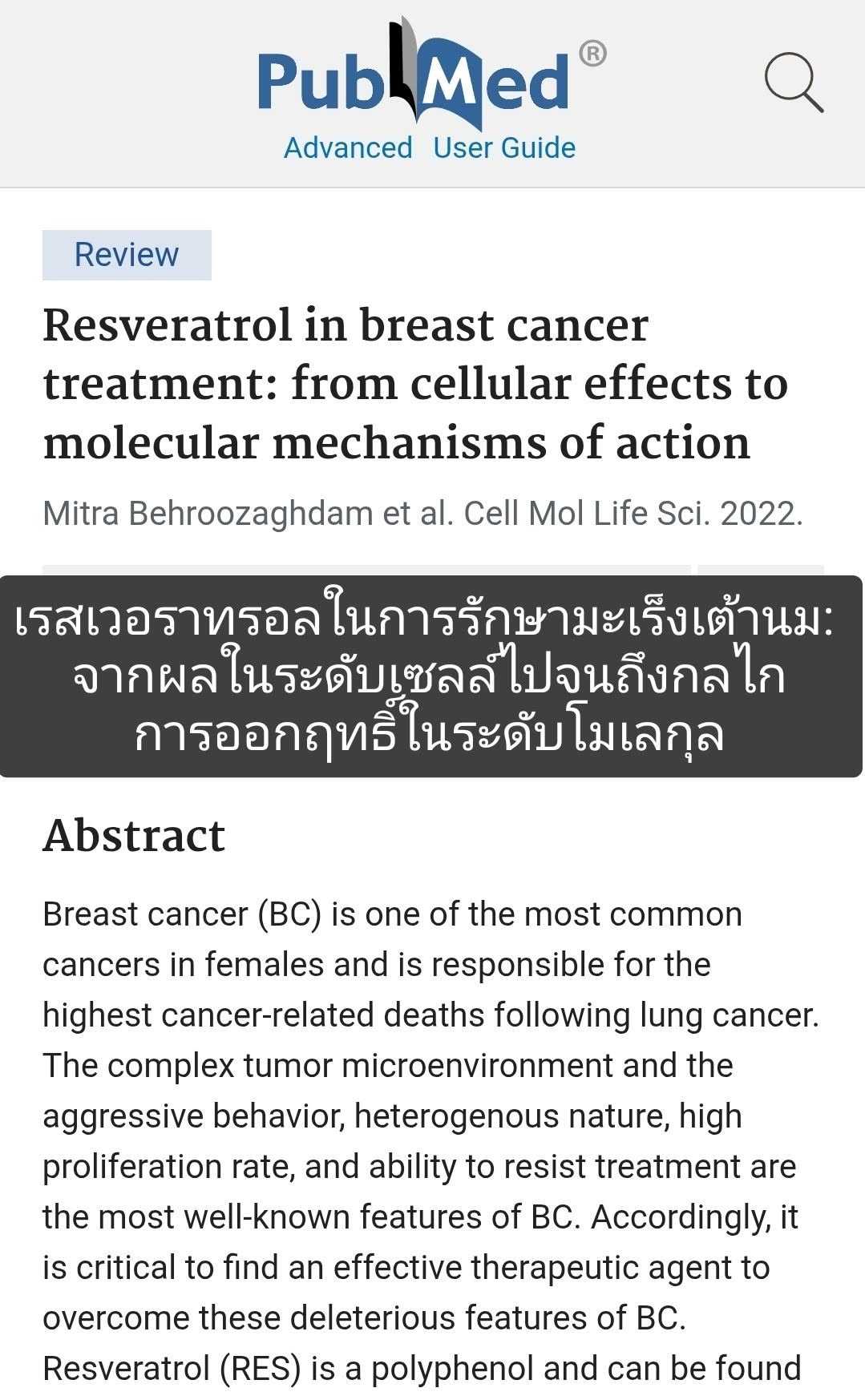
Resveratrol in breast cancer treatment: from cellular effects to molecular mechanisms of action (published 2022) as follows:
Summary of the article Resveratrol in breast cancer treatment: from cellular effects to molecular mechanisms of action (published 2022) as follows:
1. Background:
Breast cancer (breast cancer) is a disease that is most common in women. And there is a high death rate from drug resistance/progression/spread of the disease.
Resveratrol (RES) is a natural polyphenol. Found in red grapes, mulberries, and some other plants. Research has been done on diseases such as diabetes, cardiovascular disease, inflammation and cancer.
The purpose of this article is to compile the latest research on the role of resveratrol. in breast cancer both at the cellular level and molecular mechanisms
2. Main results or research – results at the cellular and molecular level:
The article divides the results into several main topics as follows:
2.1 Inhibition of cell growth / reduction of viability (proliferation / viability)
Resveratrol can stimulate breast cancer cells to enter cell cycle arrest and induce apoptosis.
at the molecular level It was found that resveratrol It works by increasing p53 expression, increasing oxidative stress within the cell, activating caspases (such as caspase-3) and reducing Bcl-2 (an anti-apoptotic protein), thereby opening the cell to apoptosis.
It also plays a role in inhibiting cellular metabolic processes (metabolism), such as inhibiting enzymes involved in glycolysis in breast cancer cells.
2.2 Inhibit metastasis / invasion / change in characteristics (metastasis / invasion / EMT):
Resveratrol has been found to reduce invasion and migration of breast cancer cells. and inhibits the epithelial → mesenchymal transition (EMT), which is an important process of cancer metastasis.
At the molecular level, MMP-2, MMP-9 (matrix metalloproteinases) are inhibited, which play a role in destroying the surrounding cell matrix and allowing cells to spread.
2.3 Promote combination therapy (synergistic / chemosensitization / radiosensitization):
One interesting point is that resveratrol has the potential to increase the effectiveness of chemotherapy drugs. (chemotherapy) and radiation (radiotherapy) in breast cancer cells, such as making cells that are resistant to drugs (drug-resistant) has increased sensitivity to the drug.
For example, research has found that resveratrol reduces the expression of HSP27, making breast cancer cells more sensitive to doxorubicin.
3. Important molecular mechanisms:
The article summarizes several molecular mechanisms such as:
Stimulation of p53 and caspase, reduces Bcl-2 → promotes apoptosis.
Inhibits EMT, reduces MMP-2/MMP-9 → reduces invasion/metastasis.
Inhibits NF-κB, Akt/PI3K, mTOR pathways which are involved in cancer cell survival. (from another source)
Promote drug-resistant cells has increased sensitivity (chemosensitization) through several mechanisms, such as inhibiting HSP27 or Rad51.
4. Conclusion:
This article concludes that resveratrol It has very interesting potential in the context of breast cancer. Both in terms of inhibiting cancer cell growth, reducing invasion/metastasis, and enhancing the efficiency of combination therapy.
Note: If looking for resveratrol to take It is recommended to choose one that is extracted from 100% natural plants because it will give good results. But most commercially available resveratrol is a synthetic chemical. If eaten, it will not be effective because the body absorbs it poorly. and has long-term effects on the liver and kidneys