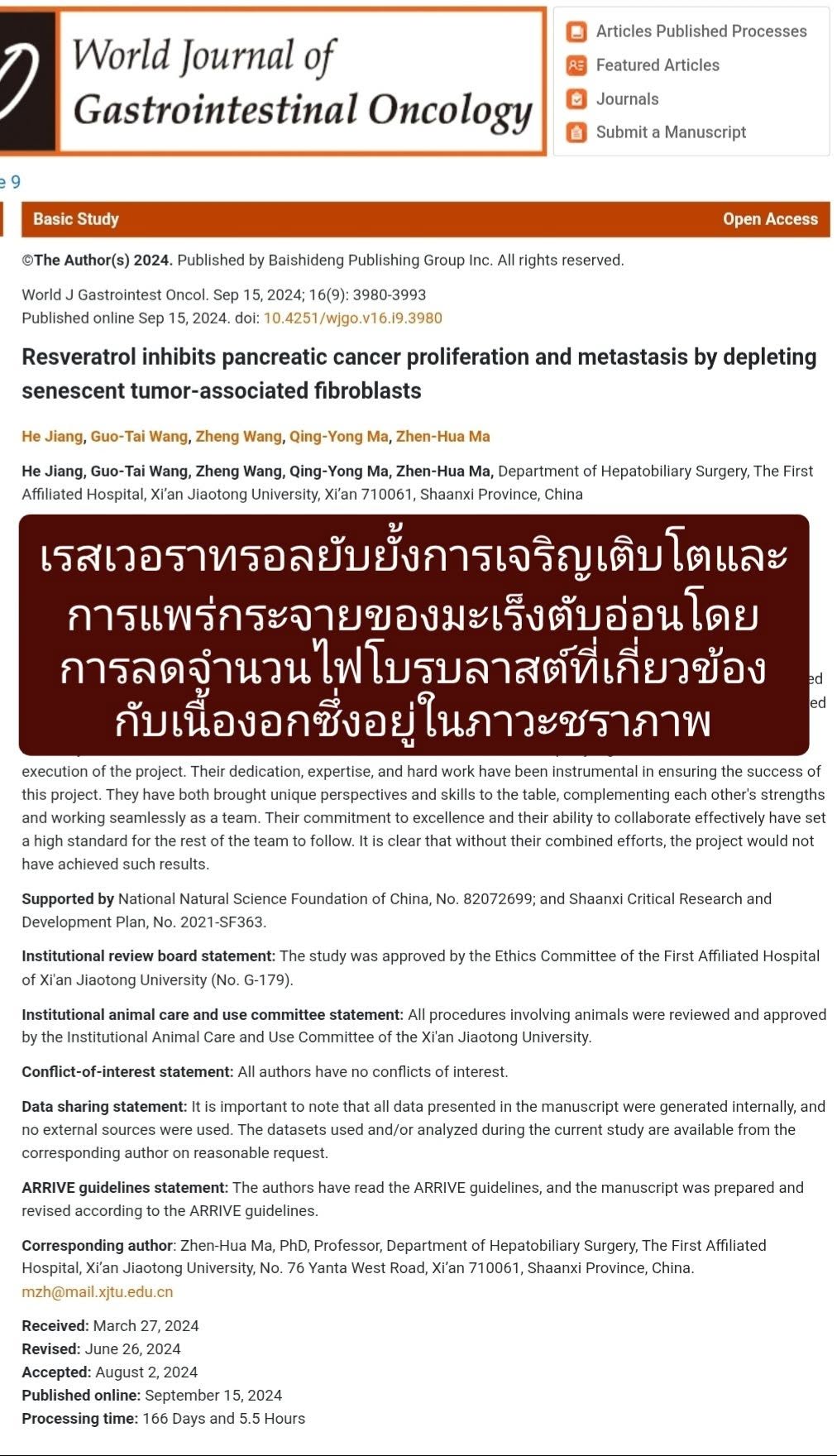
This study studied the effect of Resveratrol on pancreatic cancer. Emphasis on the role of “Aging fibroblasts” in the environment of...
Summary: This article studies the effects of Resveratrol on pancreatic cancer. Emphasis on the role of “Aging fibroblasts” in the tumor environment Also known as senescent tumor-associated fibroblasts (CAFs), these are cells that promote the growth and spread of cancer.
Summary of the main points of the research
1. Pancreatic cancer provides an environment conducive to progression.
Researchers found that in pancreatic cancer tissue there are many CAFs that are in a state of “senescence.” These cells secrete inflammatory and cancer-stimulating substances, such as IL-6, IL-8, MMP-2, and CXCL12, causing the cancer to grow and spread faster.
2. Aging fibroblasts help cancer to become more severe.
When pancreatic cancer cells were cultured together with senescent CAFs, it was found that:
● Cancer cells divide faster.
● More mobile and invasive.
● Stimulates the EMT (epithelial-mesenchymal transition) process, which is involved in cancer metastasis.
3. Resveratrol inhibits these cancer-supporting cells.
When resveratrol was used on aging CAFs, it was found that:
■ The number of senescent CAFs cells decreases.
■ Decreased secretion of inflammatory substances.
■ Decreased ability to stimulate cancer.
■ Division, movement. and the spread of cancer cells was clearly reduced
Conclusion of the research
This research suggests that resveratrol is a natural substance that can help fight pancreatic cancer. It works not only directly on cancer cells, but also reduces "cancer supporting cells" in the environment surrounding the tumor.
points of interest
This work is important because it points out that Eliminating "old" cells in tumors may provide a new way to treat cancer in the future. which is becoming an important topic in research circles in aging and cancer biology