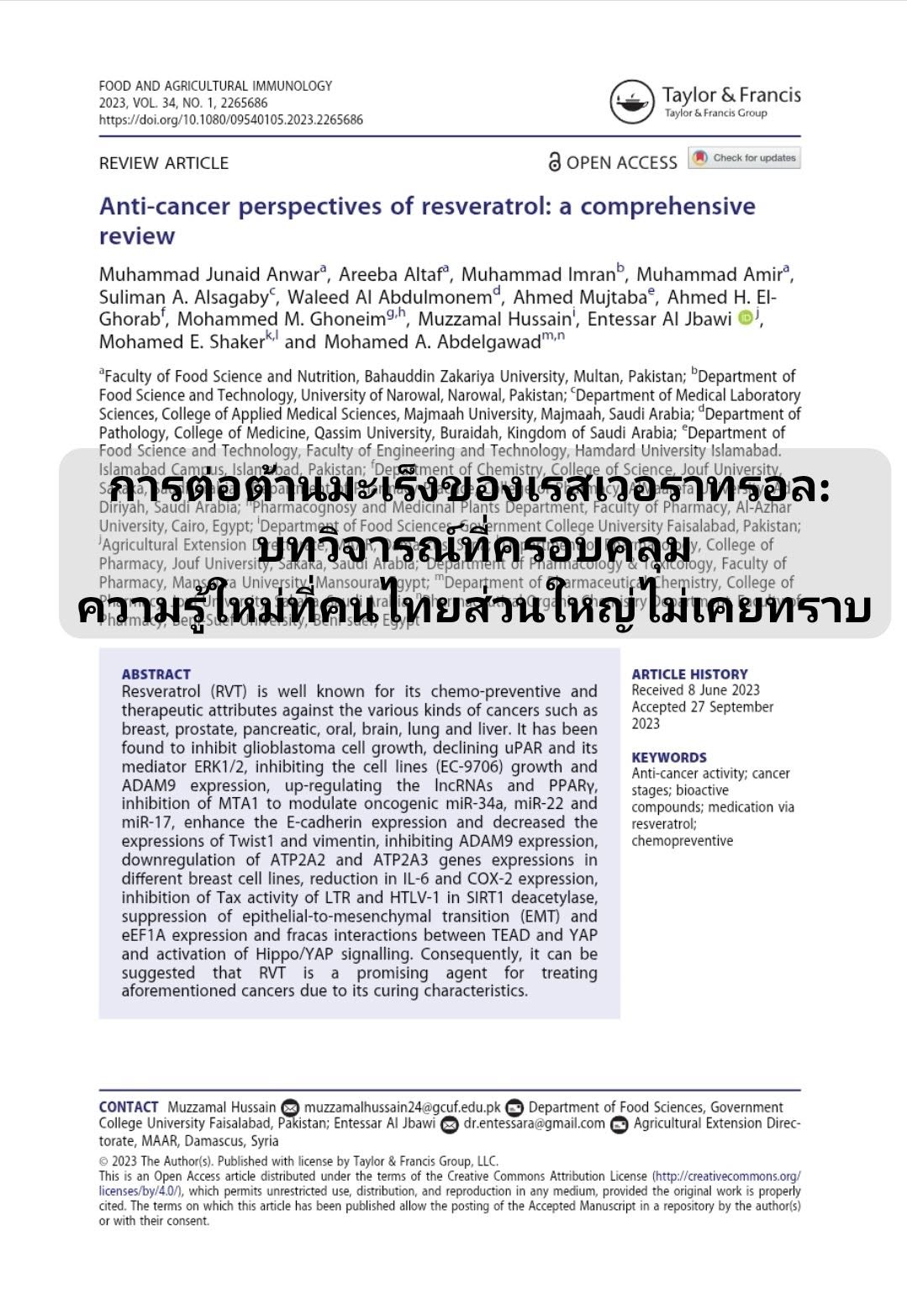
The article “Anti-cancer perspectives of resveratrol: a comprehensive review --- Anti-cancer perspectives of resveratrol: a comprehensive review...
The article “Anti-cancer perspectives of resveratrol: a comprehensive review --- Anti-cancer perspectives of resveratrol: a comprehensive review” in the abstract and information as follows:
Summary of important points from the abstract (Abstract)
Resveratrol has both protective properties. Chemo‑preventive and therapeutic for many types of cancer, including breast, prostate, pancreas, oral, brain, lung and liver.
Mechanisms that have been studied include:
Inhibits glioblastoma cell growth by reducing uPAR and ERK1/2.
Inhibits the growth of EC‑9706 cells and reduces ADAM9 expression.
Increased expression of lncRNAs and PPARγ
Inhibits MTA1 to upregulate miRNAs such as miR‑34a, miR‑22, miR‑17.
Increased E‑cadherin and reduced Twist1 and vimentin.
Reduced expression of ATP2A2 and ATP2A3 in breast cells
Reduce IL‑6 and COX‑2
Inhibits Tax activity of LTR and HTLV‑1 through SIRT1 deacetylase.
Inhibits epithelial‑to‑mesenchymal transition (EMT) and eEF1A.
Stops the interaction between TEAD and YAP and stimulates the Hippo/YAP signaling pathway.
The abstract concludes that resveratrol is a potential agent for treating these cancers. Because of the properties that help heal
Supplementary information from other related articles.
A 2024 article points out that resveratrol works through antibiotics. Antioxidants Modulation of signal paths in cells Inhibition of cell division and effects on epigenetics, including synergistic effects with chemotherapy or radiation treatment.
A 2023 MDPI article states that resveratrol Can increase the sensitivity of cancer cells to medicines. By improving drug absorption Reduce drug metabolism and reduces drug excretion from cells decreased drug resistance through the mechanisms of apoptosis, autophagy, ROS, DNA repair, stem cell targets and miRNAs.
Summary:
Resveratrol is a natural polyphenol found in red grapes, mulberries, etc.
It has the potential to both prevent and treat many types of cancer. Through various mechanisms such as:
Inhibits the growth of cancer cells
Improves cell signaling pathways (e.g. Hippo/YAP, EMT)
Regulate cancer-related miRNAs
Increased E-cadherin decreased Twist1 and vimentin associated with progression.
Reduces inflammation (IL-6, COX-2)
It can also be enhanced with chemotherapy or radiation treatments. through increasing the sensitivity of cancer cells to drugs