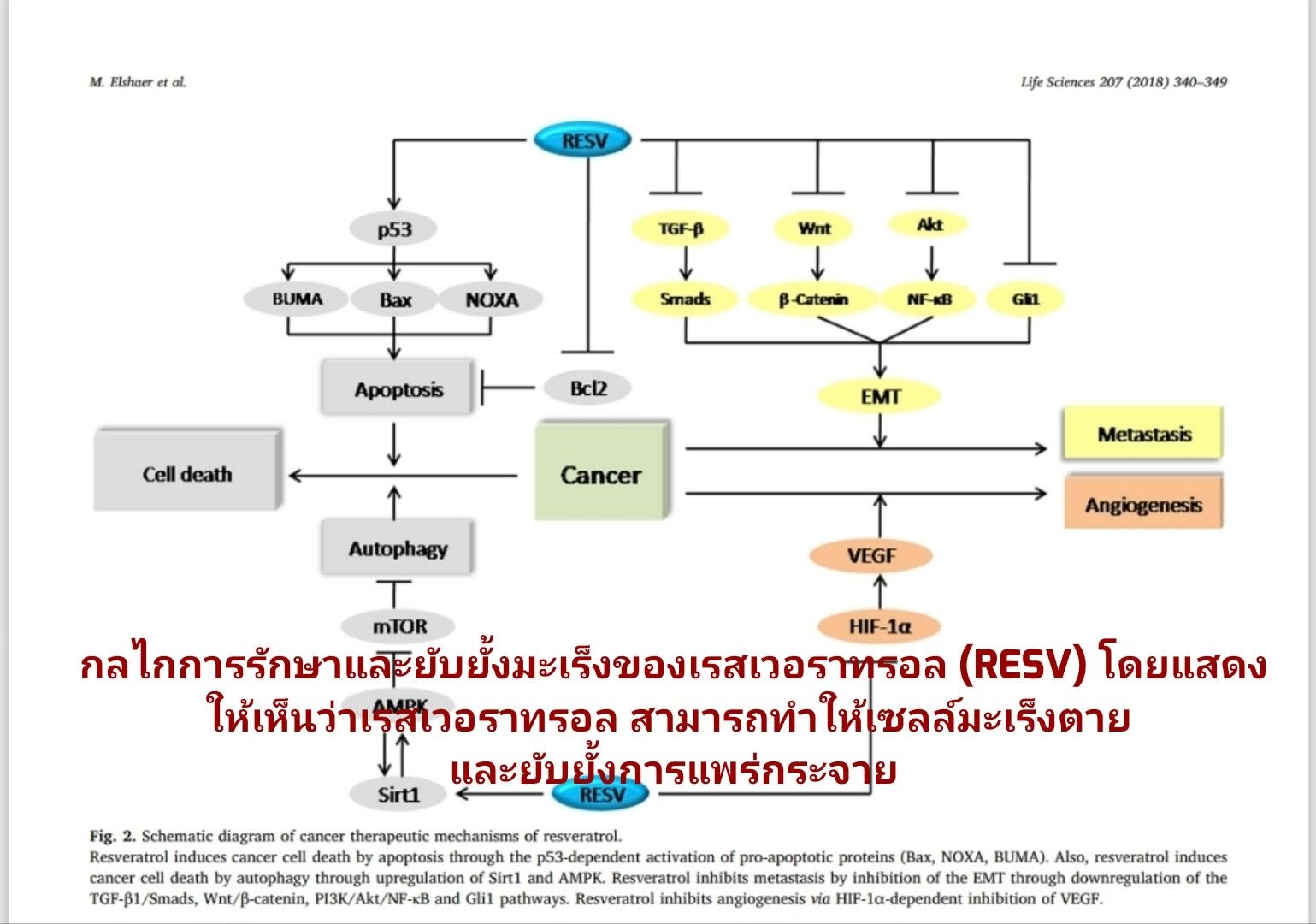
This picture is the mechanism for treating and inhibiting cancer of Resveratrol (RESV), showing that resveratrol Can make s...
This picture is the mechanism for treating and inhibiting cancer of Resveratrol (RESV), showing that resveratrol Can cause cancer cells to die and inhibits metastasis and the creation of new blood vessels. Angiogenesis occurs through several routes as follows:
1. Stimulate the death of cancer cells (Cancer cell death)
RESV → p53 → Bax, NOXA, BUMA → Apoptosis → Cell death
p53 is a protein that controls cell death (tumor suppressor).
Bax, NOXA, BUMA are proteins that induce apoptosis.
Causes cancer cells to destroy themselves (apoptosis).
RESV → AMPK → Inhibit mTOR → Stimulate Autophagy → Cell death
Autophagy is the process by which cells degrade themselves → causing cancer cells to be eliminated.
RESV → Reduce Bcl-2
Bcl-2 is a protein that helps cells survive. (anti-apoptotic protein)
Inhibiting Bcl-2 makes it easier for cancer cells to die.
2. Inhibits the spread of cancer (Anti-metastasis)
RESV inhibits TGF-β, Wnt/β-catenin, PI3K/Akt/NF-κB, Gli1 pathways.
These pathways are involved in cellular transition (EMT: Epithelial-Mesenchymal Transition).
EMT causes cancer cells to move and spread to other organs.
Inhibiting EMT = reduces chance of metastasis
3. Inhibits the creation of new blood vessels. (Anti-angiogenesis)
RESV → inhibits HIF-1α → reduces VEGF
HIF-1α stimulates the production of VEGF (Vascular Endothelial Growth Factor).
VEGF causes the creation of new blood vessels to feed the tumor.
When restrained The tumor then lacks food and oxygen → stops growing.
4. Summarize results
Resveratrol plays an important role in fighting cancer.
1. Stimulate the death of cancer cells (Apoptosis, Autophagy)
2. Inhibits metastasis (Metastasis)
3. Inhibits the creation of new blood vessels. (Anti-angiogenesis)
All of this makes resveratrol help control and reduce the severity of cancer.