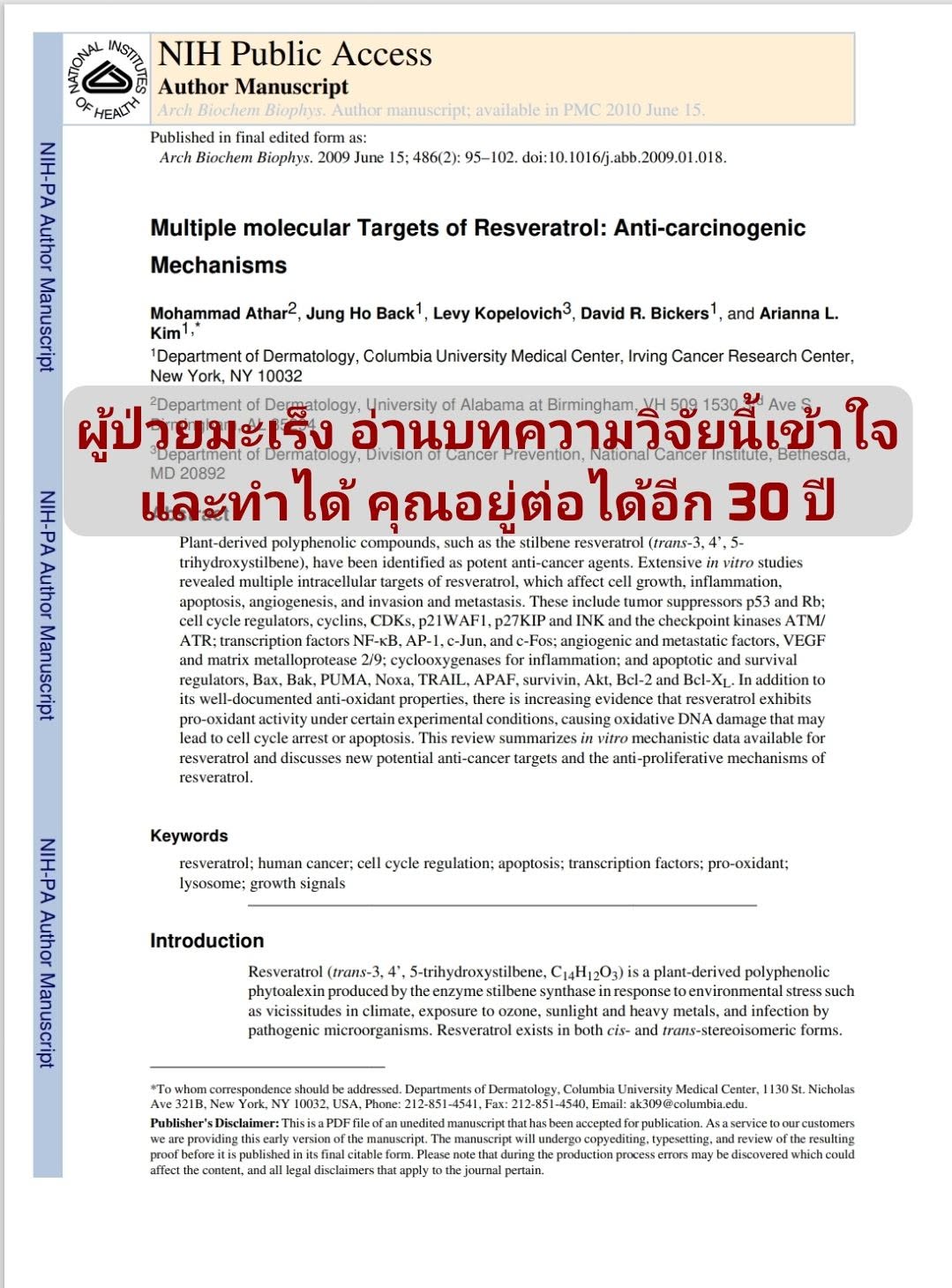
The main content of the article “Multiple molecular targets of resveratrol: Anti-carcinogenic mechanisms”
Summary of the main points of the article “Multiple molecular targets of resveratrol: Anti-carcinogenic mechanisms”
Resveratrol's Molecular Target: Anti-Cancer Mechanisms
Research was conducted at the Department of Dermatology, Columbia University Medical Center, Irving Cancer Research Center, New York, USA.
Essence:
Resveratrol is a phytochemical in the polyphenol group found in red grapes, mulberries, and some other plants. It has anti-cancer properties through acting on multiple targets at the cellular level.
The main mechanisms of resveratrol involved in inhibiting cancer include:
1. Cell Cycle Regulation
Inhibits cell division by stimulating anti-proliferative proteins such as p21, p27.
Suppress the activity of Cyclins and CDKs → causing cancer cells to stop at the G1/S or G2/M stage.
Activates p53 and related genes → Leads to cell growth arrest or death.
2. Stimulation of cell death process (Apoptosis)
Activates Bax, Bak, PUMA, Noxa proteins and inhibits Bcl-2, Bcl-XL.
Activation of caspase through both pathways mitochondrial and death receptor (Fas/TRAIL)
Works with chemotherapy or radiation to increase the death of cancer cells.
3. Inhibition of proliferation and angiogenesis. (Anti-metastasis & Anti-angiogenesis)
Reduces the activity of MMP-2 and MMP-9 → Delays the invasion of cancer cells.
Inhibits angiogenesis by repressing the expression of VEGF and HIF-1α.
4. Reducing inflammation (Anti-inflammatory effect)
Inhibits COX-2 and NF-κB, which are involved in chronic inflammation and cancer.
MKP5 is stimulated to reduce the activity of p38 MAPK and JNK.
5. Control of Transcription Factors
Suppress the activity of NF-κB, AP-1 → reduce the expression of genes related to cancer cell survival and metastasis.
Activation of p53 → leads to apoptosis
6. New goals and additional mechanics
Cathepsin D (lysosomes): Resveratrol can induce apoptosis through this route.
AMPK pathway: induces cells to enter energy stress → leads to apoptosis
Pro-oxidant activity: Under certain conditions, resveratrol can generate ROS, causing DNA damage and apoptosis.
7. Conclusion and Application
Resveratrol is a substance with great potential to prevent and slow down cancer. It acts on many routes simultaneously.
Clinical studies have shown it to be very safe.