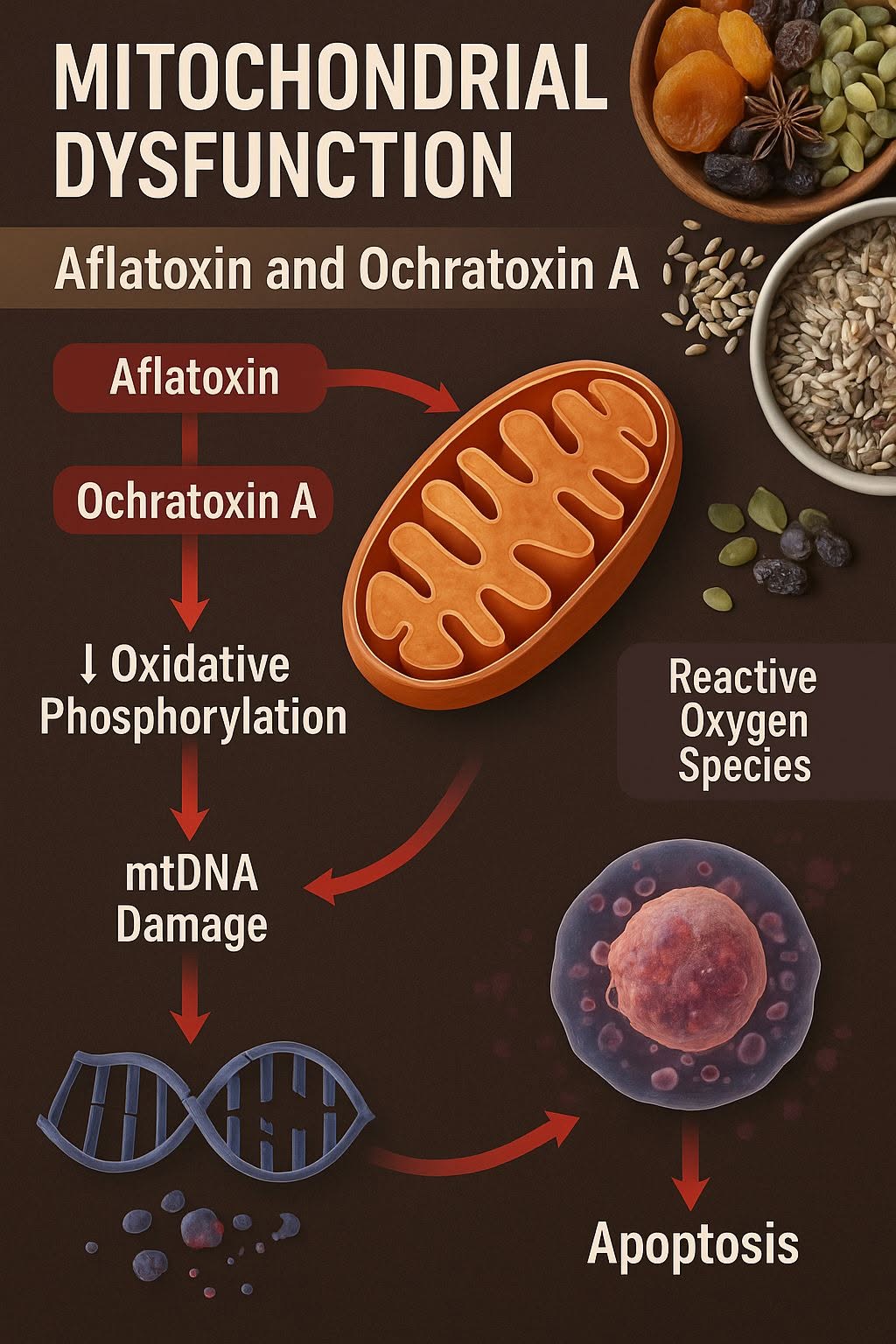
Biological mechanisms of Impaired functioning of the mitochondria (mitochondrial dysfunction) caused by exposure to the carcinogen aflatol...
Biological mechanisms of Impaired functioning of the mitochondria Mitochondrial dysfunction caused by exposure to the carcinogens Aflatoxin and Ochratoxin A (OTA) is complex and involves several routes as follows:
1. Direct effect on the mitochondria
Inhibition of energy production (Oxidative Phosphorylation (OXPHOS))
Aflatoxin and ochratoxin A can interfere with the activity of enzymes in the Electron Transport Chain (ETC), especially Complex I and Complex III → resulting in decreased ATP production.
Electron leakage occurs, resulting in the production of abnormally high amounts of Reactive Oxygen Species (ROS).
Mitochondrial membrane damage
Ochratoxin A has direct mitochondrial toxin properties → causing the permeability transition pore (mPTP) to open abnormally.
Resulting in the protein Cytochrome c (Cytochrome c) leaking out → stimulating the apoptosis process.
2. Induction of oxidative stress (Oxidative Stress)
Both substances cause the creation of ROS and RNS (Reactive Nitrogen Species) out of control.
ROS damage membrane lipids (lipid peroxidation), mitochondrial structural proteins, and mtDNA.
Damage to mtDNA impairs the production of proteins required for ETC → the cycle is further impaired.
3. Effects on metabolism and biochemical signals
Inhibits enzymes that use NADH/NADPH.
Ochratoxin A inhibits the activity of several enzymes such as succinate dehydrogenase → reduces the flow of the Krebs cycle (TCA cycle).
Affects cell death signals (apoptosis & necrosis)
ROS and cytochrome c leakage → activation of caspase cascade → apoptosis.
When severe → Mitochondria rupture and necrosis occurs.
4. Carcinogenicity induction
Aflatoxin: Changed by the enzyme CYP450 → Forms Aflatoxin B1-8,9-epoxide that binds to DNA and mtDNA → Causes mutations (e.g. p53 mutation).
Ochratoxin A: In addition to destroying mitochondria It also induces fibrosis and the accumulation of abnormal cells in the kidneys and liver → increasing the risk of cancer.
5. Food and health context
Main sources of contamination: dry food, spices, grains, coffee.
Long-term accumulation Even in low doses → Makes the mitochondria chronically weak → Leads to chronic diseases such as
Liver cancer (hepatocellular carcinoma) from aflatoxin.
chronic kidney disease and kidney cancer from ochratoxin A
Some types of nervous system degeneration from oxidative stress on the mitochondria.
Conclusions: Aflatoxin and ochratoxin A impair mitochondrial function through ETC disruption, abnormally high ROS generation, mtDNA damage, and induction of cell death → which are directly linked to the development of cancer and chronic diseases.