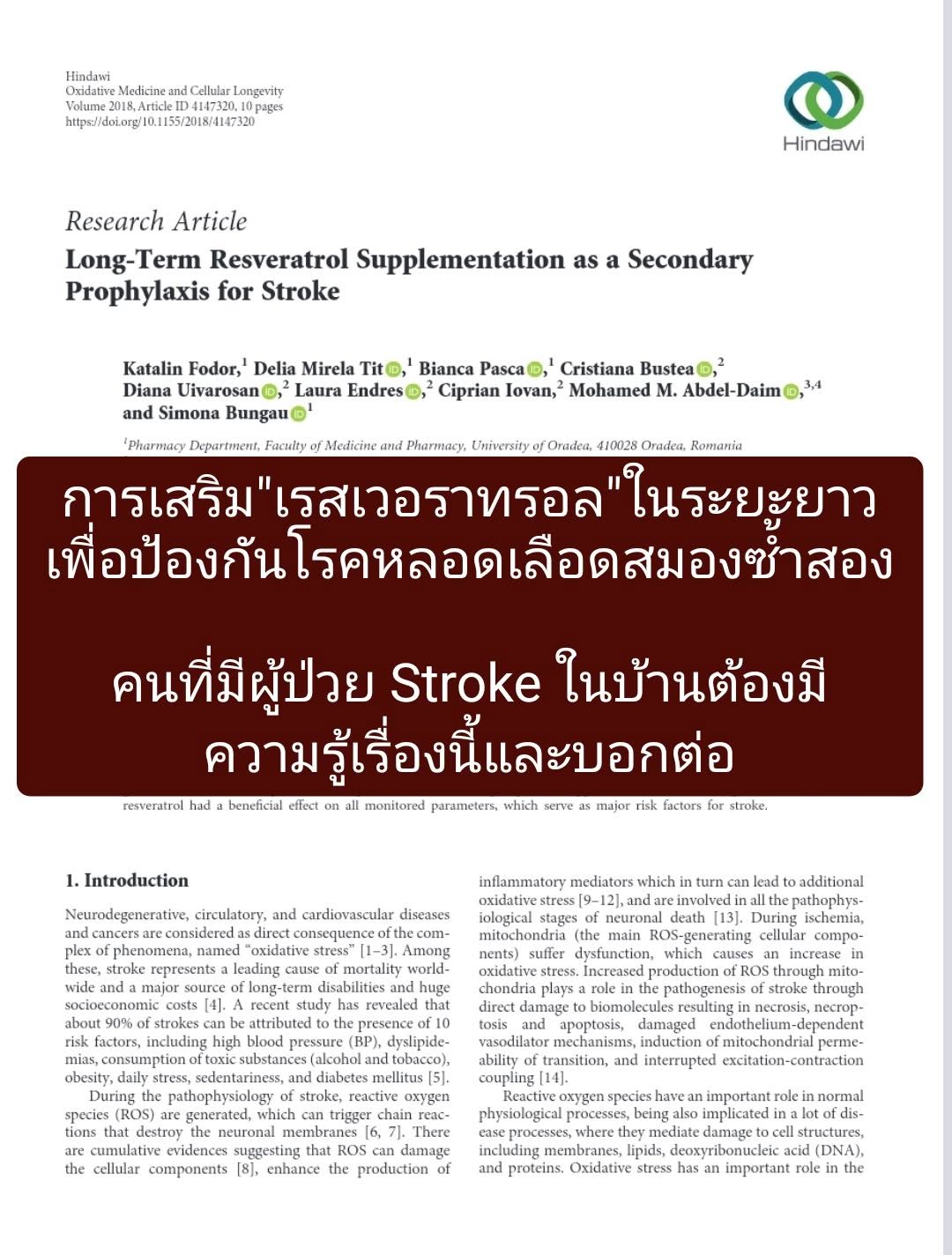
“Long-Term Resveratrol Supplementation as a Secondary Prophylaxis for Stroke” published in the journal Wiley Online Library study...
Summary of the article “Long-Term Resveratrol Supplementation as a Secondary Prophylaxis for Stroke” published in the Wiley Online Library journal, studying the effect of “resveratrol” on the long-term prevention of recurrent stroke (secondary prevention).
Research objectives
The researcher wants to see that Can continuing to take resveratrol help reduce “risk factors” associated with recurrent strokes, such as?
- high blood pressure
- Abnormal blood fat
- High blood sugar
- Overweight/High BMI
- Oxidative stress and inflammation
Method of study
228 stroke patients
All had had a stroke within 12 months before the study began.
Divided into 3 groups
- treatment group
- Control group maintains general standards.
- Group 100 mg, standard treatment + Resveratrol 100 mg/day
- Group 200 mg standard treatment + Resveratrol 200 mg/day
Follow up for 12 months.
Important results
1. Blood pressure drops
Both the 100 mg and 200 mg groups had a more pronounced decrease in blood pressure than the control group, especially systolic BP.
Example:
From approximately 148–149 mmHg
It decreased to approximately 139 mmHg after 12 months.
2. BMI and weight improve
The resveratrol group had a marked reduction in BMI, with the 200 mg group seeing a slightly greater effect.
Researchers explain that resveratrol:
- Reduce fat creation
- Increase fat breakdown
- Helps the function of mitochondria
3. Blood fat improves
Found that:
- LDL decreased
- Triglyceride decreased
- HDL increased
Especially the 200 mg group had the most prominent effect on triglyceride.
4. Sugar levels improve
In non-diabetic patients:
glucose decreased significantly
Proposed mechanism:
- stimulates SIRT1
- Stimulates AMPK, which is involved in energy regulation and insulin sensitivity.
The mechanism by which resveratrol is thought to help.
Research explains that stroke is related to oxidative stress and free radicals (ROS).
Resveratrol has properties:
● Antioxidants
● Reduce inflammation.
● Protects blood vessel lining.
● Helps endothelial function.
● Reduce brain damage after ischemia.
Researcher's conclusion
The researcher concludes:
> Long-term resveratrol supplementation in combination with standard treatment Helps reduce important risk factors for repeated strokes.
By: can be used as “Adjunct therapy” is possible.