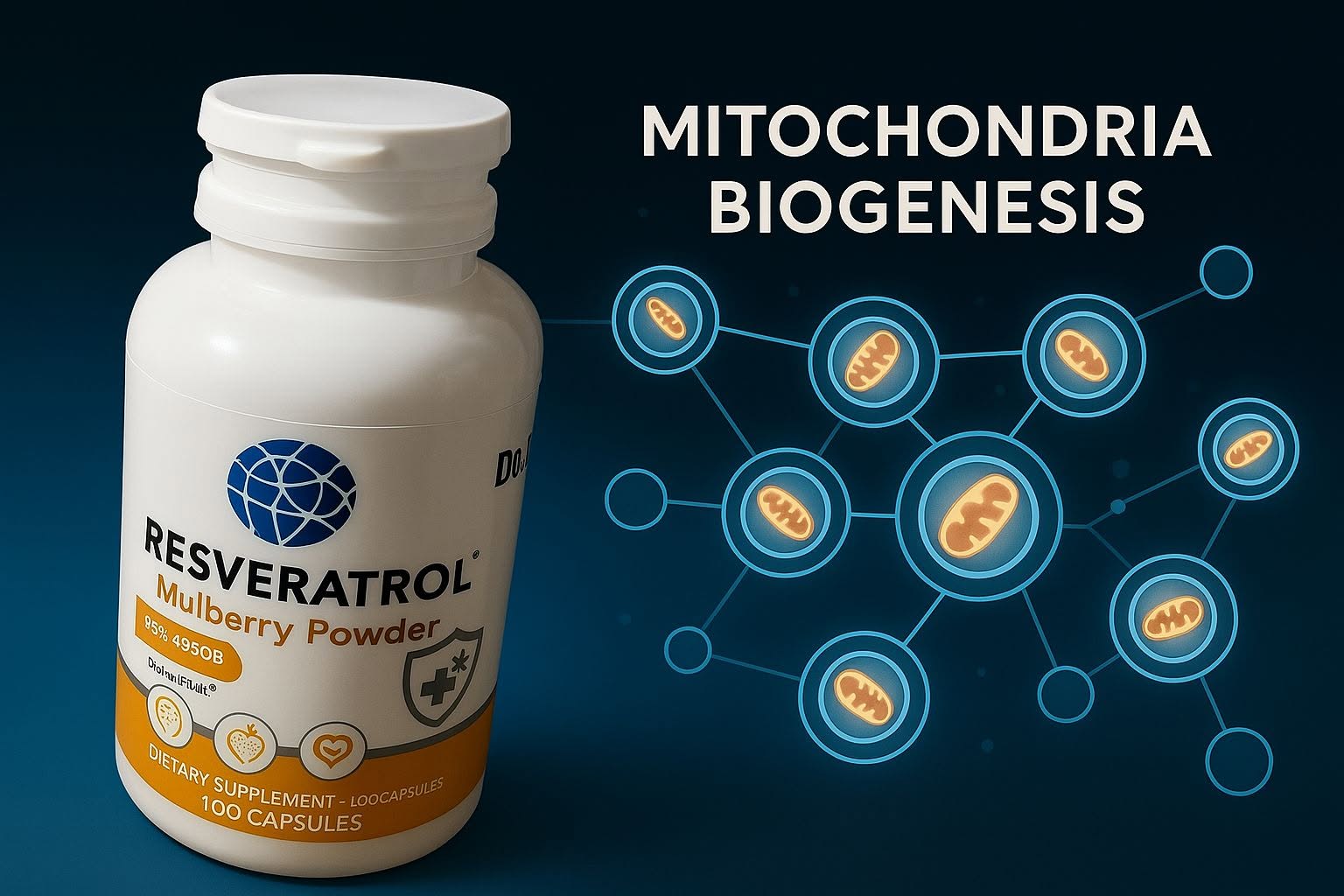
Biological mechanism of resveratrol extracted from mulberry in strengthening mitochondria To prevent cancer
Biological mechanism of resveratrol extracted from mulberry in strengthening mitochondria To prevent cancer
New knowledge has emerged that impaired function and reduced number of mitochondria in cells is one of the key factors leading to cancer. In particular, the Warburg Effect mechanism, in which cancer cells switch to relying on glucose and glutamine for energy instead of using oxygen as usual. Strengthening the Mitochondria Mitochondria biogenesis is therefore a potential approach in fighting cancer.
Resveratrol, a polyphenol compound found in mulberries It plays an important role in stimulating this process through several biological mechanisms as follows:
1. SIRT1 (Sirtuin 1) stimulation:
* Main role: SIRT1 is a protein deacetylase that responds to nutrient starvation and acts as It is a "master regulator" of cell metabolism and aging.
* Mechanism of Resveratrol: Resveratrol is recognized as a direct SIRT1 activator by binding to SIRT1 and increasing its activity.
* Effects on Mitochondria: SIRT1 activation has several effects on strengthening the mitochondria:
* Deacetylation of PGC-1α (Peroxisome Proliferator-Activated Receptor Gamma Coactivator-1 Alpha): PGC-1α is a master regulator of mitochondrial formation. Deacetylation by SIRT1 increases the stability and activity of PGC-1α, resulting in increased expression of genes involved in mitochondrial formation (e.g. NRF1, NRF2, TFAM).
* Deacetylating FOXO3a (Forkhead Box Protein O3a): SIRT1 can deacetylate FOXO3a, a transcription factor involved in antioxidation and autophagy. Stimulating FOXO3a can promote the elimination of damaged mitochondria (mitophagy), which is important in maintaining the quality of the mitochondria.
* NAD+ regulation: SIRT1 requires NAD+ as a coenzyme. Resveratrol may help maintain NAD+/NADH balance, which is important for SIRT1 activity and mitochondrial function.
2. Stimulation of AMPK (AMP-activated Protein Kinase):
* Main role: AMPK is an enzyme that acts as The cell's "energy sensor" is activated when ATP (energy) levels in the cell are low and promotes the process that creates ATP.
* Mechanism of Resveratrol: It has been reported that resveratrol can stimulate AMPK directly or indirectly through changes in the AMP/ATP ratio.
* Effects on Mitochondria: AMPK activation has a direct effect on strengthening the mitochondria by:
* Phosphorylate PGC-1α: AMPK can phosphorylate PGC-1α, increasing the activity and stability of PGC-1α, resulting in the expression of genes involved in mitochondrial formation.
* SIRT1 regulation: AMPK and SIRT1 work together in a mutually reinforcing loop. AMPK can increase NAD+ levels, which is required for SIRT1, and SIRT1 can also stimulate AMPK.
3. Reducing damage from free radicals (Antioxidant Effects):
* Main role: Excessive free radicals (Reactive Oxygen Species, ROS) can damage DNA, proteins, and lipids of the mitochondria. This results in the mitochondria not functioning properly.
* Mechanism of Resveratrol: Resveratrol is a highly effective antioxidant. It can directly scavenge free radicals and stimulate the activity of intracellular antioxidant enzymes (such as superoxide dismutase, catalase, glutathione peroxidase).
* Effects on Mitochondria: Reducing free radical damage helps protect mitochondria from damage. Maintain normal structure and function. which is important for building quality mitochondria.
4. Improving the functioning of the mitochondrial network (Mitochondrial Dynamics):
* Main role: Mitochondria undergo continuous fusion and fission to maintain the balance of the mitochondrial network. Abnormal functioning of these processes can lead to mitochondrial defects.
* Mechanism of resveratrol (From some studies): Although the mechanism is not as clear as stimulating SIRT1/AMPK, studies suggest that resveratrol may have an effect on regulating proteins involved in mitochondrial dynamics, such as Mfn1/2 (mitofusin 1/2) and OPA1 (optic atrophy 1), which are involved in mitochondrial assembly, and Drp1 (dynamin-related protein 1), which is involved in fission.
* Effects on Mitochondria: Promoting the balance of Mitochondrial dynamics allow cells to remove damaged mitochondria and form new, healthy ones.
Summary:
Resveratrol extracted from mulberry has the potential to strengthen mitochondria through complex biological mechanisms. This is primarily through the activation of SIRT1 and AMPK, which are key regulators of mitochondrial formation. It also acts as an antioxidant that protects the mitochondria. and may play a role in improving Mitochondrial dynamics: Restoring the function and number of mitochondria in cancer cells. May help inhibit the Warburg Effect and force cancer cells to return to aerobic respiration. This can lead to a slowdown in the growth or even death of cancer cells.