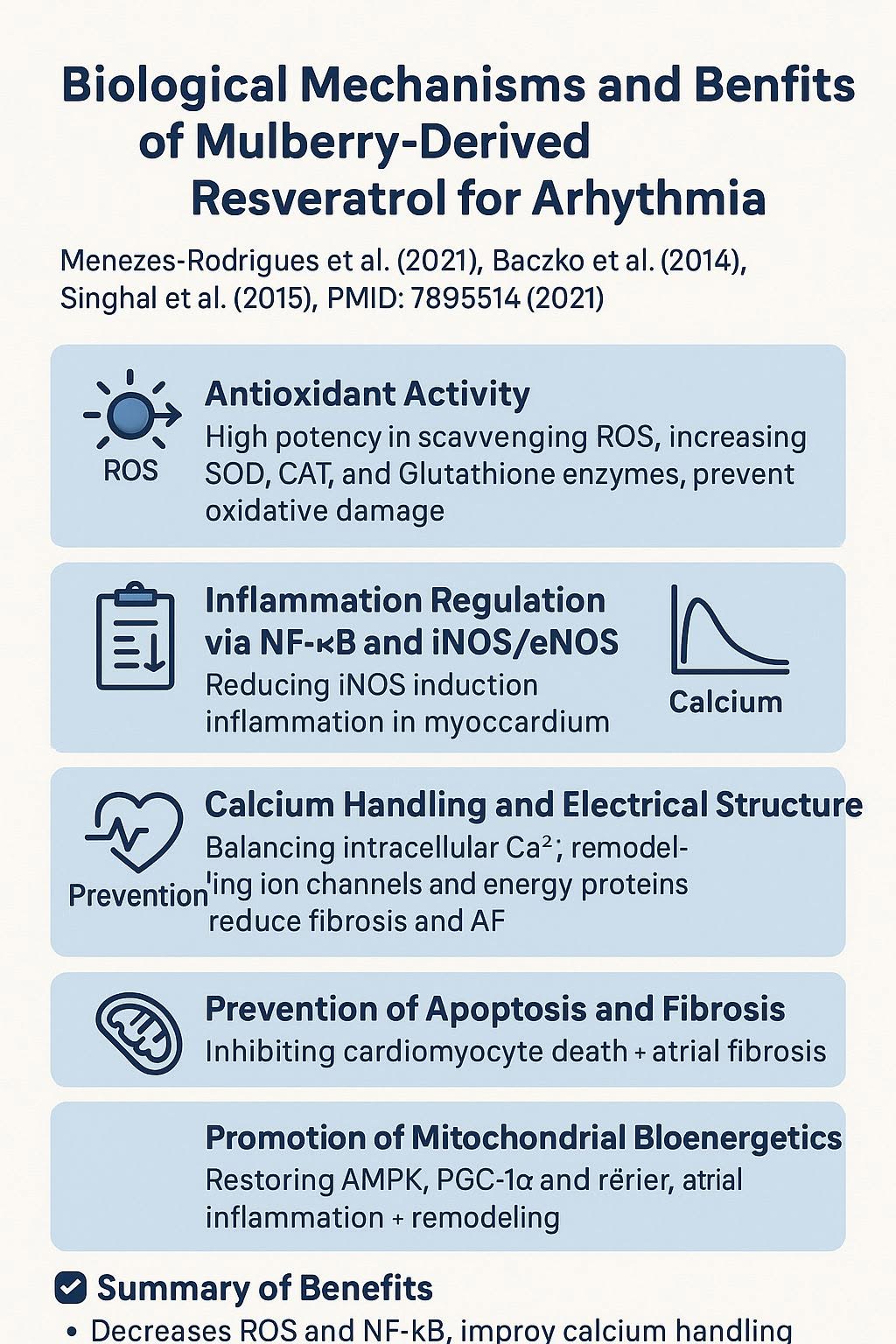
Biological mechanisms and benefits of resveratrol extracted from mulberry (Morus alba) on cardiac arrhythmias. With research articles...
Biological mechanisms and benefits of resveratrol extracted from mulberry (Morus alba) on cardiac arrhythmias. Along with 5 related research articles:
Biological mechanisms of resveratrol
1. **Antioxidant effect (Antioxidant)**
Resveratrol from mulberry is highly effective in scavenging ROS, increasing SOD, CAT and glutathione enzymes. Prevents damage from oxidative stress that is an important factor in AR/VF.
2. Control inflammation through NF‑κB and iNOS/eNOS.
Reduced iNOS induction and inflammation through NF‑κB in a cardiac ischemia‑reperfusion model. and reduces inflammation in the heart muscle
3. Regulates calcium flow and electrical structure
Balances intracellular Ca²⁺, reduces leakage from SR, regulates remodeling of ion channels and energy proteins such as SERCA2a, phospholamban via PI3K/AKT/eNOS, reduces fibrosis and susceptibility to AF.
4. Prevent apoptosis and fibrosis.
Inhibit the death of Cardiomyocyte and cardiac fibrosis, especially in the atrium, result in decreased inducibility of AF.
5. Promote energy subsystems and mitochondrial bioenergetics
Restoring the activity of AMPK, PGC‑1α, helping the energy system within the cell. and reduces inflammation along with restructuring the metabolism of the atrium
5 research articles (summary)
1. Li et al., 2021.
Resveratrol and Polydatin were detected in mulberries.
There is an antioxidant effect in HepG2 along with reducing ROS, MDA and increasing SOD, CAT, GSH.
2. Menezes-Rodrigues et al., 2021.
In the ischemia/reperfusion model: resveratrol reduces VT/VF, AV block, and mortality.
Mechanism through iNOS/eNOS, regulating Ca²⁺, preventing mitochondrial dysfunction.
3. Baczko et al. / Chong et al.
Long-term use of resveratrol: Reduces apoptosis, fibrosis and modulates the expression of the ion channel, SERCA2a via PI3K/AKT/eNOS, resulting in reduced AF inducibility.
4. Singhal et al., 2015: Resveratrol reduced fibrosis, regulated ion channels (Kv1.4, Kir2.1, Nav1.5, Cav1.2), markedly increased PI3K/AKT/eNOS, and decreased AF inducibility.
5. PMID:7895514 (2021)
Mouse AMI + H9C2 cells: Resveratrol reduces ROS, increases SOD, GSH, GPx, reduces IL‑1β, IL‑6 through inhibiting NF‑κB — protecting the heart muscle.
Summary of benefits for heart arrhythmias
Main mechanism, effect on AR/AF disease
Antioxidants reduce ROS, the cause of Ca²⁺ leak/trigger.
Reduces inflammation, inhibits NF‑κB/iNOS, reduces fibrosis.
Adjust Ca²⁺ handling to restore SERCA2a ion channel model.
Prevents apoptosis and maintains atrium structure
Adjust cell energy, enhance AMPK/PGC‑1α, reduce metabolic stress.
→ Taken together: Resveratrol reduces the chance of arrhythmias by protecting heart cells, reducing fibrosis, and stabilizing the electrical system.
AR and AF are medical abbreviations related to atrial fibrillation:
AR = Arrhythmia → Total arrhythmia. It may be too fast, too slow, or inconsistent.
AF = Atrial Fibrillation → Atrial fibrillation It is one of the most common types of arrhythmia. The upper chamber of the heart beats quickly and irregularly.