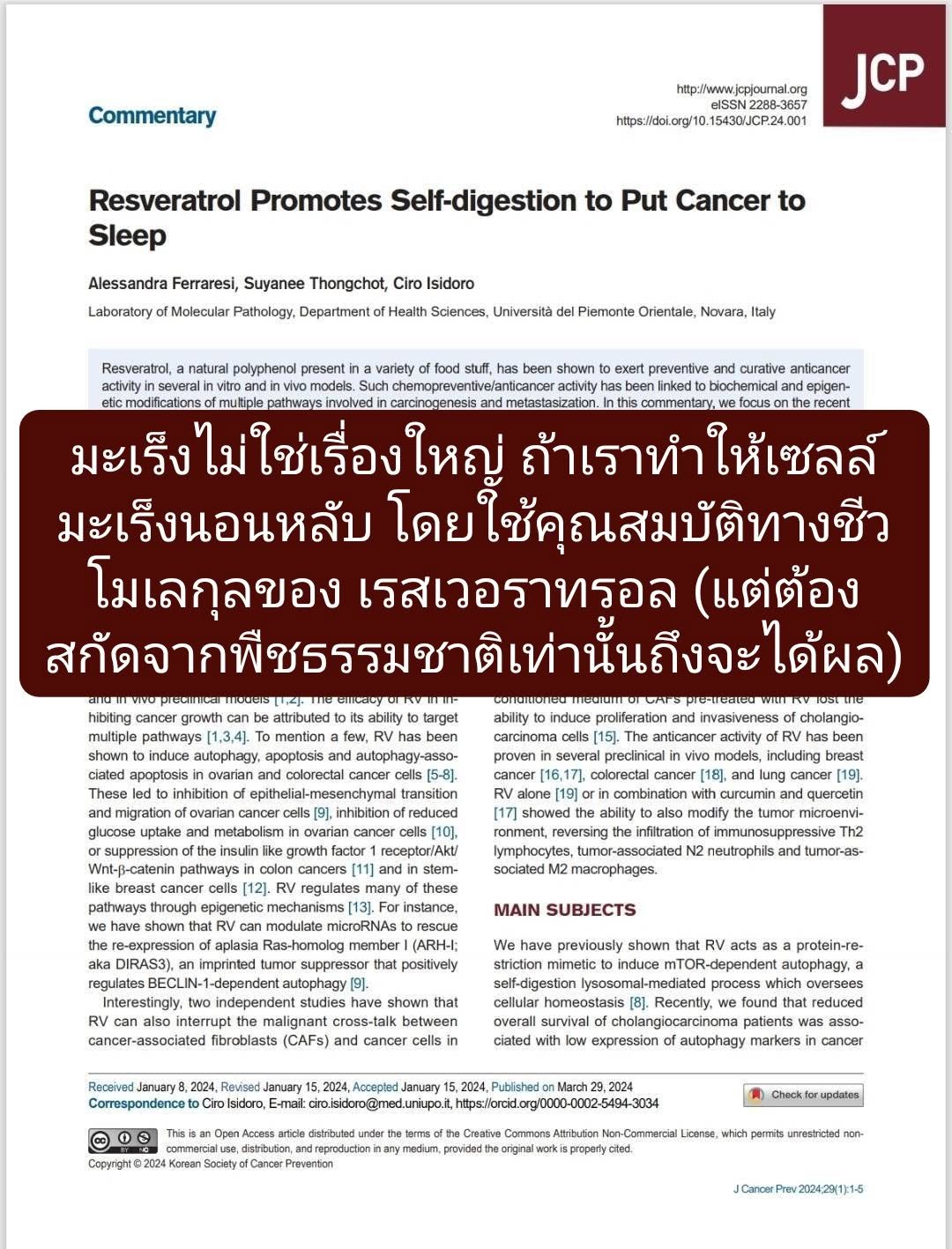
This academic article is a Commentary (academic opinion piece) published in the Journal of Cancer Prevention (JCP) ...
This academic article is a Commentary published in the Journal of Cancer Prevention (JCP) in 2024 with the topic "Resveratrol Promotes Self-digestion to Put Cancer to Sleep" by a team of researchers from Italy. which focuses on collecting and analyzing in-depth mechanisms of Resveratrol at the molecular level. To inhibit and control cancer cells
Here is a review and summary of key points from a molecular biology perspective and its applications:
1. Molecular mechanism highlights: Autophagy-Dependent Tumor Dormancy
This article points out a very interesting mechanism. This is not just killing cancer cells directly (Apoptosis) in general, but is an issue. "Putting cancer cells to sleep" (Tumor Dormancy) through the process of epigenetic control. (Epigenetic-mediated) and cell self-eating (Autophagy):
● Protein-Restriction Mimetic:** RV acts as a protein restriction mimetic, which stimulates the protein-restriction process. mTOR-dependent autophagy results in cancer cells undergoing a process of autophagy at the lysosome level. (Lysosomal-mediated process) to maintain cell balance. But in the context of cancer It causes cancer cells to stop dividing and enter a dormant state.
● Epigenetic Regulation & MicroRNAs:** The article states that RV is able to restore the expression of the tumor-restriction gene ARH-I (DIRAS3) through epigenetic mechanisms and regulation of microRNAs, which the ARH-I gene plays a key role in activating. BECLIN-1-dependent autophagy
2. Modifying the environment around the tumor (Tumor Microenvironment)
Another interesting point is The authors emphasize that RV does not act alone on cancer cells, but has a significant impact on the Tumor Microenvironment (TME):
● Interrupting CAFs Cross-talk: RV can break the abnormal communication cycle between cancer cells and Cancer-associated fibroblasts (CAFs). CAFs are important factors that promote the progression and recurrence of cancer.
● Inhibition of Signaling Pathways:** RV inhibits signaling through Cyclin D1, c-Myc, STAT3 (stimulated by IL-6), and Akt, which are key signaling pathways that cancer uses to grow and maintain stem-like properties.
● Immune Reversing: RV's capabilities (either alone or alone) are discussed. or used in combination with Curcumin and Quercetin) to modify the immune environment around the tumor. By reducing the infiltration of immunosuppressive immune cells, such as Th2 lymphocytes, Tumor-associated N2 neutrophils, and M2 macrophages, to regain their anti-cancer function better.
3. Medical perspectives and applications (Clinical Translation)
Although this article focuses on data obtained from in vitro (test tube) and in vivo (test animal) models in several types of cancer, such as ovarian cancer, colon cancer, breast cancer, lung cancer, and bile duct cancer, (Cholangiocarcinoma) But the main clinical challenge of Resveratrol that is often discussed is: Bioavailability (absorption and utilization by the body) due to the natural nature of Resveratrol when ingested Will be changed in the liver quickly (rapid metabolism), causing the amount of actually active substances in the bloodstream to be quite low. Therefore, extraction technology and delivery system (Delivery system) that preserves its value and helps the body absorb it for maximum efficiency without being destroyed by heat or harsh chemical processes. Therefore, it is the key to developing a high-quality dietary supplement. Medical-grade
Conclusion: This is a valuable commentary article confirming and updating the in-depth mechanism of Resveratrol as a bioactive compound with great potential for cancer control. In particular, the focus has changed from destroying cells to "Regulating the environment" and "calming cancer cells" are concepts that are consistent with today's health care and anti-aging medicine.