Aging is a disease: new insights in medical science
Aging is a disease: new insights in medical science
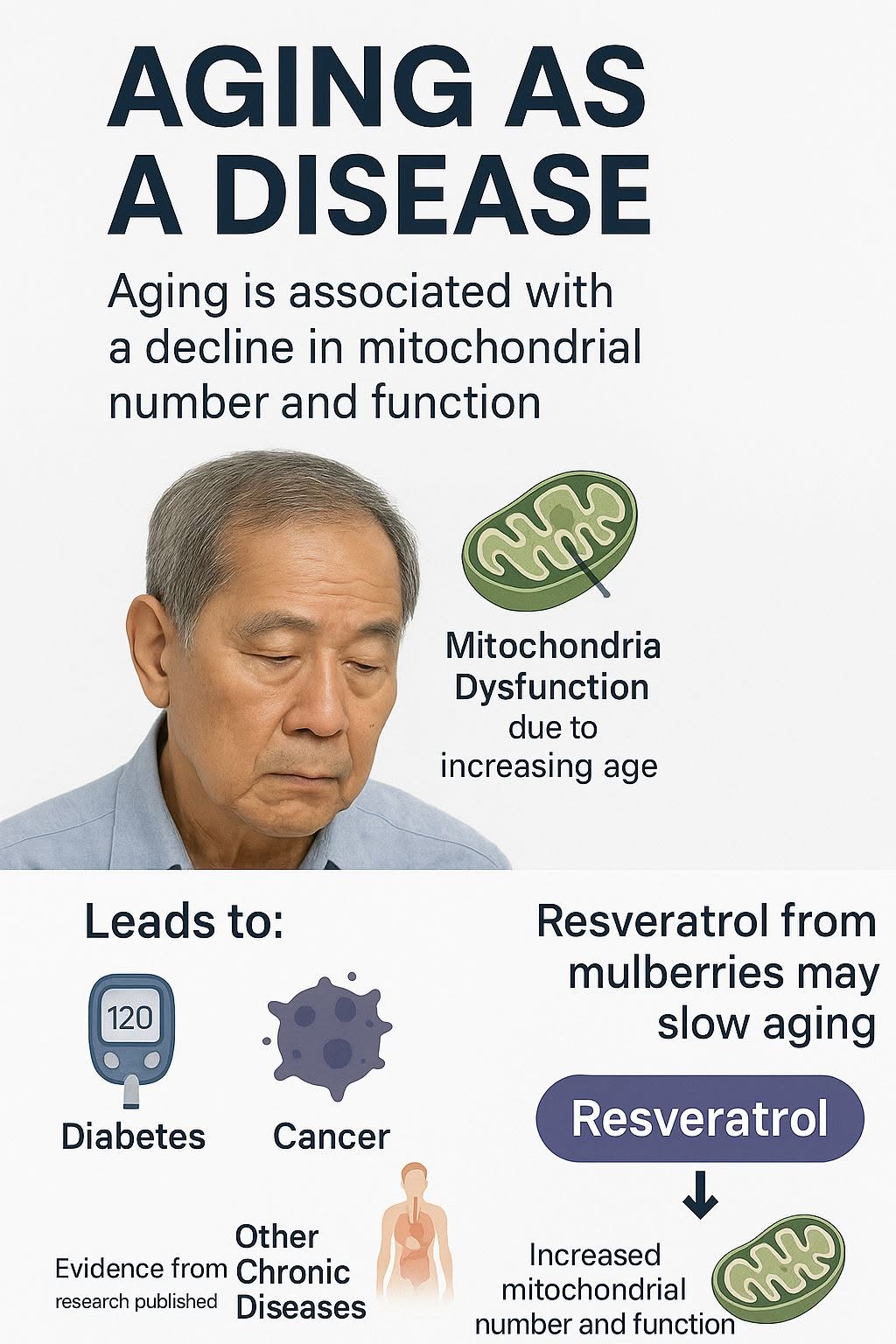
In the past, “aging” (Aging) was viewed as a natural process that could not be avoided. But at present Scientific advances have changed this view. The World Health Organization (WHO) has classified "aging" as a chronic condition or disease. which can be slowed down or managed
Mitochondrial degeneration: the heart of aging.
Mitochondria are the “energy factories” of cells that play a key role in producing the energy (ATP) needed to function in many organs in the body. As we age:
The number of mitochondria in the cell decreases.
Abnormalities occur in work, such as decreased energy production.
Reactive Oxygen Species (ROS) are created increased, causing damage to DNA, proteins, and lipids.
Leads to “Mitochondrial dysfunction” which is a major cause of non-communicable chronic diseases (NCDs) such as diabetes, high blood pressure. cardiovascular disease to cancer
Resveratrol from mulberry: an anti-aging active ingredient.
Resveratrol is a type of polyphenol found in abundance in mulberries. There are many biomolecular studies published in the PubMed database supporting the role of resveratrol in delaying the aging process and restoring mitochondria, such as:
1. SIRT1 and PGC-1α activation
Resveratrol can stimulate the protein SIRT1, an anti-aging protein.
This results in the activation of PGC-1α (Peroxisome proliferator-activated receptor gamma coactivator 1-alpha), which is an important factor that controls the formation of new mitochondria. (mitochondrial biogenesis)
Increase the number and quality of mitochondria in the cell.
2. Reduce inflammation and oxidative stress (Oxidative stress)
Resveratrol reduces ROS levels and chronic inflammation at the cellular level.
Protects DNA and proteins from damage
As a result, cells have a longer lifespan. and work efficiently
3. Increases insulin sensitivity and reduce the risk of NCDs
Resveratrol affects glucose metabolism.
Improves response to insulin which is directly related to the development of type 2 diabetes and metabolic syndrome
Summary:
Aging is considered a “disease” caused by the deterioration of the mitochondria.
Resveratrol from mulberry plays an important role in delaying aging and preventing NCDs through stimulating SIRT1 and PGC-1α.
Research from reliable sources like PubMed confirms resveratrol's potential to increase the number and efficiency of mitochondria.
The following are research articles published in the PubMed database that confirm the role of resveratrol. (Resveratrol) to delay aging and strengthen mitochondria. With a brief summary of the content:
1. Resveratrol-Mediated Regulation of Mitochondria Biogenesis: A Review
Source: PubMed Central (PMC10286596)
Conclusion: This review article summarizes research showing that resveratrol can enhance the regeneration of mitochondria. (mitochondrial biogenesis) by stimulating important factors such as PGC-1α, SIRT1, AMPK, ERRs, TERT, TFAM, NRF-1 and NRF-2, which are involved in preventing neurodegeneration and delaying aging.
2. Resveratrol Attenuates Aging-Induced Mitochondrial Dysfunction and Cardiac Remodeling
Source: PubMed (PMID: 40226768)
Conclusion: Studies have shown that resveratrol reduces age-related mitochondrial degeneration. and reduce changes in heart structure related to aging By improving mitochondrial function and inhibiting mitochondrial-related cell death.
3. Resveratrol and/or Exercise Training Counteract Aging-Associated Decline of Physical Endurance
Source: PubMed (PMID: 29230719)
Conclusion: Studies have shown that resveratrol supplementation combined with exercise improves physical endurance. It stimulates new mitochondria through increasing the expression of PGC-1α and increasing the activity of citrate synthase, a measure of mitochondrial function.
4. Mitochondrial Protection by Resveratrol
Source: PubMed Central (PMC3123408)
Summary: This article concludes that resveratrol plays a protective role in mitochondria by reducing oxidative stress and inflammation through activating SIRT1, which leads to increased mitochondrial regeneration and improved mitochondrial function.
Summary overview:
These studies confirm that resveratrol has the potential to delay aging and strengthen mitochondria through mechanisms such as activating SIRT1, PGC-1α, and AMPK, which results in the formation of new mitochondria. Reduce oxidative stress and improve the function of mitochondria