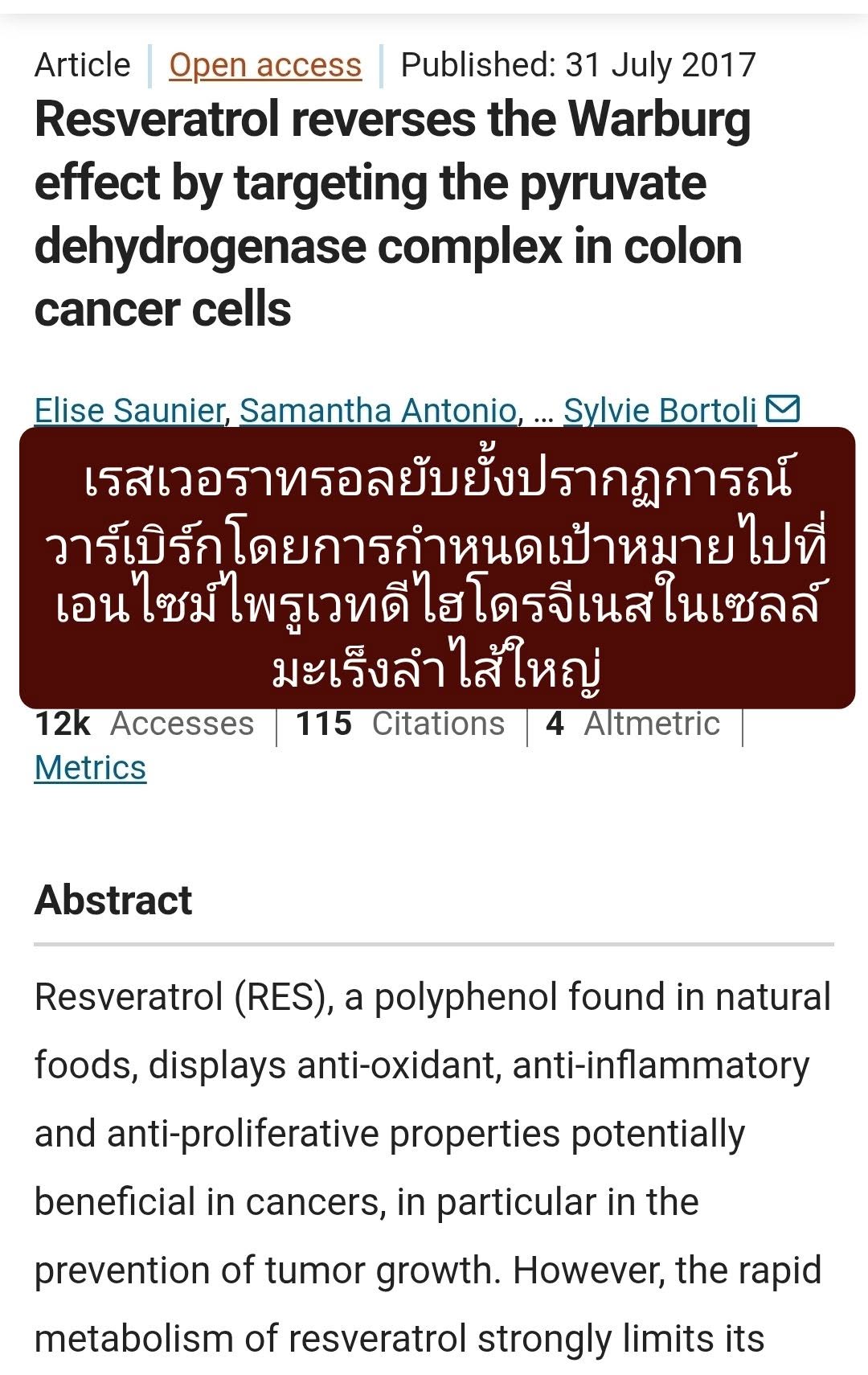
This from the journal Scientific Reports studied the effects of Resveratrol on colon cancer cells. It was found that Resveratrol can "reverse...
Summary of this article from the journal Scientific Reports. Study of the effect of Resveratrol on colon cancer cells. It was found that Resveratrol can “reverse” the abnormal energy metabolism of cancer cells. Also known as the Warburg effect, this is achieved through the stimulation of an important enzyme in the mitochondria called Pyruvate Dehydrogenase (PDH).
What is the Warburg effect?
Cancer cells are most often used. Abnormally high “glycolysis” even though there is enough oxygen. Instead, it uses energy production in the mitochondria (oxidative phosphorylation or OXPHOS).
The result is:
- Cancer cells grow quickly
- Creates high lactic acid
- Supports the division and progression of cancer.
What the research found:
Researchers used Caco2 colon cancer cells and administered 10 µM of Resveratrol and found that:
1. Slow down the growth of cancer cells.
Resveratrol reduces the division of cancer cells and causes cells to enter a partial cell cycle arrest state.
2. Metabolic shift from glycolysis → OXPHOS.
Resveratrol causes:
- Reduce the use of sugar by glycolysis.
- Reduce lactate production
- Increases oxygen use in the mitochondria.
- Increases ATP production more efficiently
The main idea is this: Cancer cells are “forced” to return to a similar energy system as normal cells.
Important mechanism: stimulates the PDH complex
The PDH enzyme is the “gateway” between glycolysis and the energy production cycle in the mitochondria.
Research has found that Resveratrol:
- Increase PDH activity
- Reduces phosphorylation that causes PDH to be turned off.
- Increase PDP1 protein, which helps activate PDH.
This concept is summarized by the equation:
When PDH works better:
- Pyruvate will enter more mitochondria.
- Reduce the conversion to lactate.
- Reduces the Warburg effect of cancer cells.
The role of AMPK and Calcium
Researchers have also found that Resveratrol works through:
- Calcium signals in the mitochondria
- AMPK pathway, which is a control system for cellular energy.
When AMPK is inhibited, the effects of Resveratrol are reduced, indicating that AMPK plays an important role in altering the metabolism of cancer cells.
The importance of research This work supports the idea that:
“Adjusting the metabolism” of cancer cells It is a way to treat cancer in the future.
Resveratrol isn't just an antioxidant. But it also directly affects the energy system of cancer cells.
PDH and PDK have become important targets for the development of metabolic therapy of anticancer drugs.