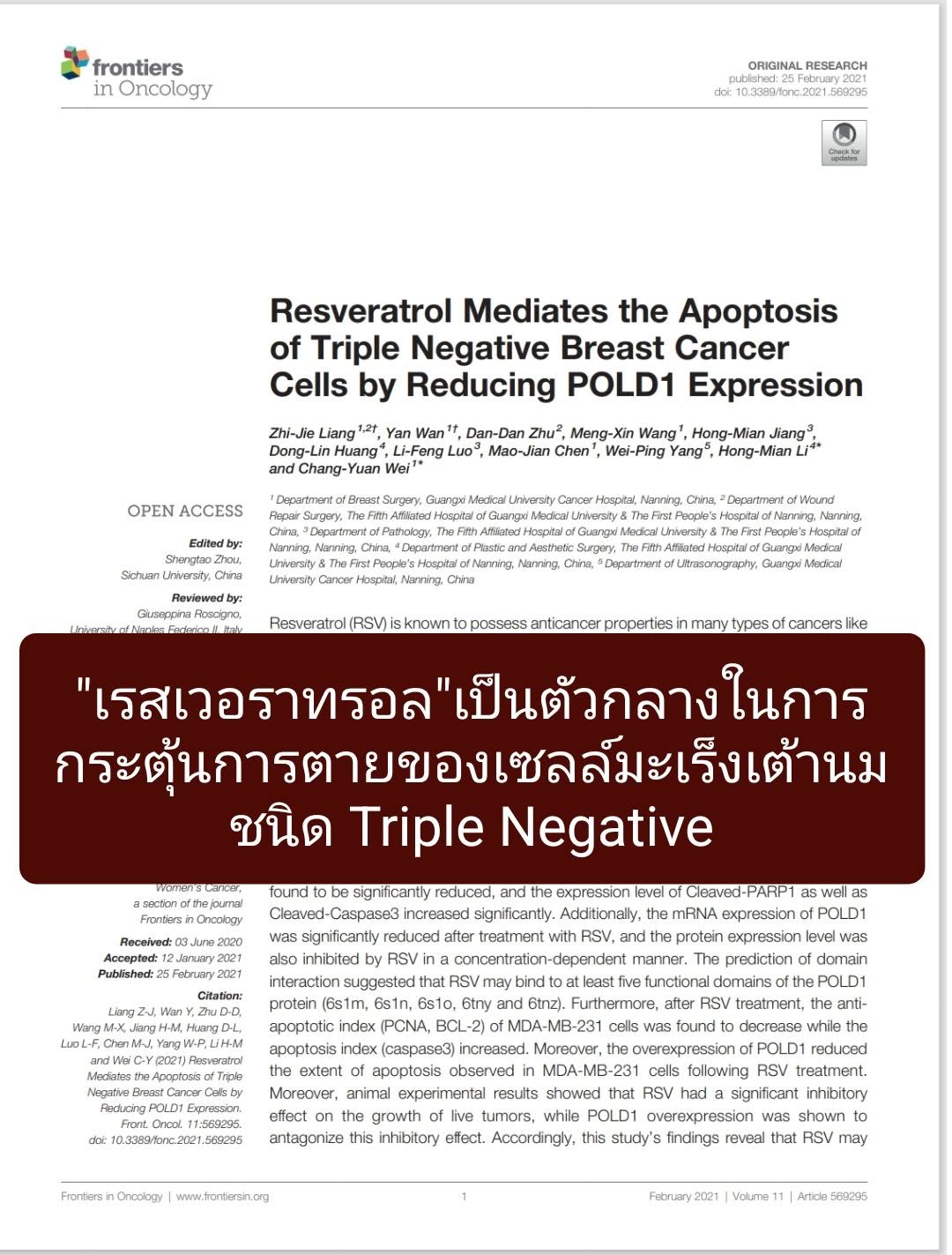
“Resveratrol Mediates the Apoptosis of Triple Negative Breast Cancer Cells by Reducing POLD1 Expression” published in the journal...
Summary of the article “Resveratrol Mediates the Apoptosis of Triple Negative Breast Cancer Cells by Reducing POLD1 Expression” published in the journal Frontiers in Oncology in 2021 studied the effect of “Resveratrol” on Triple Negative Breast Cancer (TNBC), a type that is difficult to treat and is highly aggressive.
Summary of main points
1. Resveratrol causes cancer cells to die by apoptosis.
Using MDA-MB-231 breast cancer TNBC cells, researchers found that when increasing the concentration of Resveratrol:
- The growth of cancer cells is reduced.
- More cells undergo "apoptosis" or programmed death.
- The higher the concentration, the more obvious the results.
2. The key target is the POLD1 gene.
Research has found that Resveratrol reduces the expression of the POLD1 gene, a gene involved in:
- DNA replication
- DNA repair
- Division of cancer cells
In breast cancer, POLD1 is often abnormally high. and is associated with a poor prognosis.
3. When POLD1 decreases → the cancer cell killing system is activated.
After receiving Resveratrol, important protein changes were found, such as
- BCL-2 decreases → Cells are less protected against death.
- PCNA decreases → division decreases
- Cleaved-Caspase-3 increases → stimulates apoptosis
- Cleaved-PARP1 increases → Cell death signals increase.
In short, Resveratrol “turns off the survival switch” of cancer cells.
4. The experiment was reversed and found that POLD1 actually played a role.
Researchers added POLD1 back into cancer cells and found that:
- Resveratrol's cell-killing effect is reduced.
- More cancer cells survive
Therefore, it can be concluded that POLD1 is an important mechanism used by Resveratrol to inhibit TNBC.
Conclusion of the research:
This work suggests that resveratrol inhibits triple negative breast cancer by reducing POLD1 activity and stimulating cancer cell death.