Describe the relationship between the cancer tumor suppressor gene TP53 and resveratrol.
Describe the relationship between the cancer tumor suppressor gene TP53 and resveratrol.
The cancer tumor suppressor gene TP53 encodes the protein p53, which plays a key role in cancer prevention by regulating cell cycle arrest. Programmed cell death, DNA repair, and aging are the result of cellular stress and DNA damage.
Resveratrol and TP53:
Resveratrol, a natural polyphenol found in red grapes, peanuts, and mulberries. It has been studied extensively for its potential anti-cancer properties. Resveratrol is involved in activating and stabilizing p53, which enhances its function as a tumor suppressor.
Mechanisms by which resveratrol influences TP53:
p53 activation:
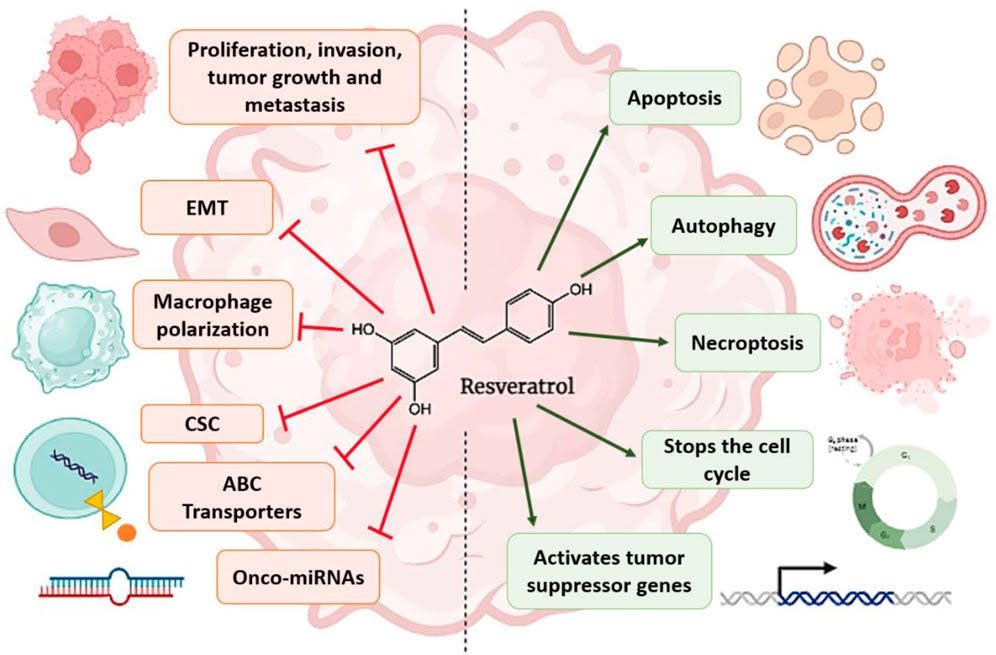
Resveratrol increases the expression and phosphorylation of p53, which leads to increased transcription of p53 target genes involved in apoptosis and cell cycle regulation (such as p21, Bax, and Puma).
Induction of apoptosis:
Resveratrol promotes mitochondrial apoptosis by stabilizing p53 through activation of pro-apoptotic proteins and inhibition of anti-apoptotic proteins.
Stopping the cell cycle:
Stimulation of p53 by resveratrol causes p21 activation, which in turn inhibits cyclin dependent kinase (CDK), causing G1 or G2/M phase arrest.
Reducing the degradation of p53:
Resveratrol inhibits MDM2, an E3 ubiquitin ligase that promotes p53 degradation, thus stabilizing p53 levels.
DNA damage response:
Resveratrol enhances p53's role in DNA repair mechanisms, reducing the chance of genetic mutations that can lead to cancer.
Induction of aging:
In some cell types, stimulating p53 with resveratrol promotes cellular senescence. This is a condition in which cells stop growing permanently. This prevents cancer cells from changing.
Implications for cancer therapy:
Conventional p53 cancer tumors: Resveratrol increases the activity of p53, which leads to the inhibition of cancer tumors.
Mutated p53 cancer tumors: Studies have shown that resveratrol can restore the function of mutated p53. Although the effects depend on the type of mutation.
Conclusion:
Resveratrol acts as a p53 activator, increasing its tumor suppressive function through induction of apoptosis. stopping the cell cycle and response to DNA damage This makes resveratrol a promising compound for cancer prevention and therapy.