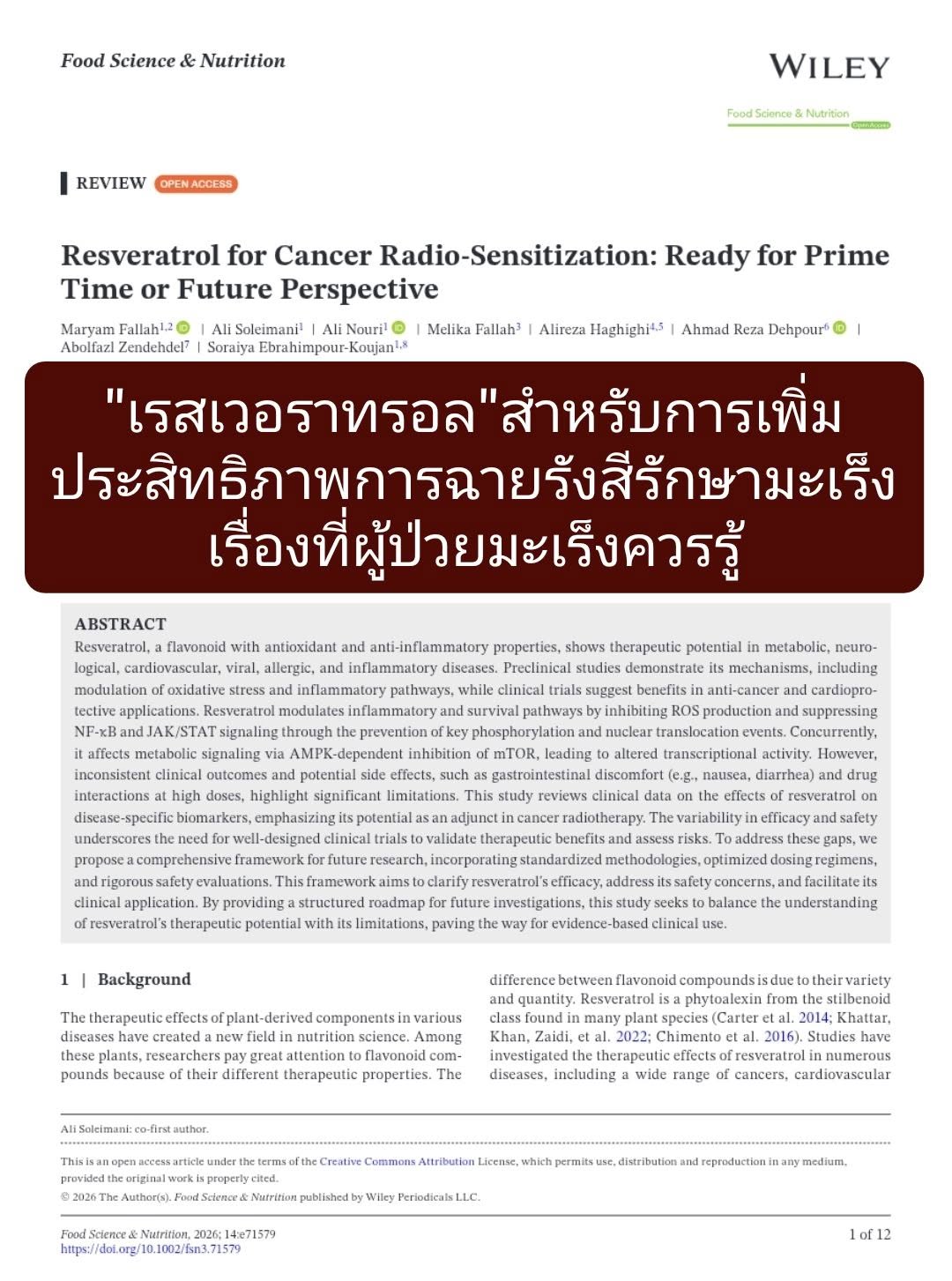
Academic topic "Resveratrol for Cancer Radio‐Sensitization: Ready for Prime Time or Future Perspective" published in...
A summary of the academic article "Resveratrol for Cancer Radio‐Sensitization: Ready for Prime Time or Future Perspective" published in the PMC archives. This is an in-depth review of the literature on the role of "Resveratrol" (Resveratrol), which is a phytochemical As a substance that improves the efficiency of radiotherapy (Radio-sensitizer) to destroy cancer cells
The main points of the article can be summarized as follows:
1. Current challenges in radiotherapy
Radiation (Radiotherapy) is one of the main methods of treating cancer. But there are two important limitations:
* Radioresistance: Some cancer cells can adapt. Develop self-repair mechanisms and resistant to radiation
* Side effects on normal cells: Using high doses of radiation to kill cancer cells. Often destroys surrounding normal tissue.
2. Parallel Role of Resveratrol (Dual Effect)
The article points out that Resveratrol has amazing properties and is very useful in medicine. Because it gives two opposite but complementary results (Selective action):
* Increased sensitivity to radiation in cancer cells (Radiosensitization): Helps cancer cells be destroyed by radiation more easily.
* Protect normal cells (Radioprotection): Acts as an antioxidant. Helps reduce damage and side effects of radiation that will occur to normal tissues of the body.
3. Mechanism of action in fighting cancer
Resveratrol inhibits cancer cells through several biological molecular mechanisms, such as:
* Inhibits DNA repair: inhibits the process by which cancer cells repair themselves after being damaged by radiation.
* Stimulate cell death (Apoptosis): signal cancer cells to naturally destroy themselves.
* Control the cell cycle (Cell Cycle Arrest): Stops the division and growth of cancer cells.
* Reduce drug and radiation resistance: Inhibit proteins and genes that cause cancer cells to become resistant to treatment.