academic
Summary of academic articles
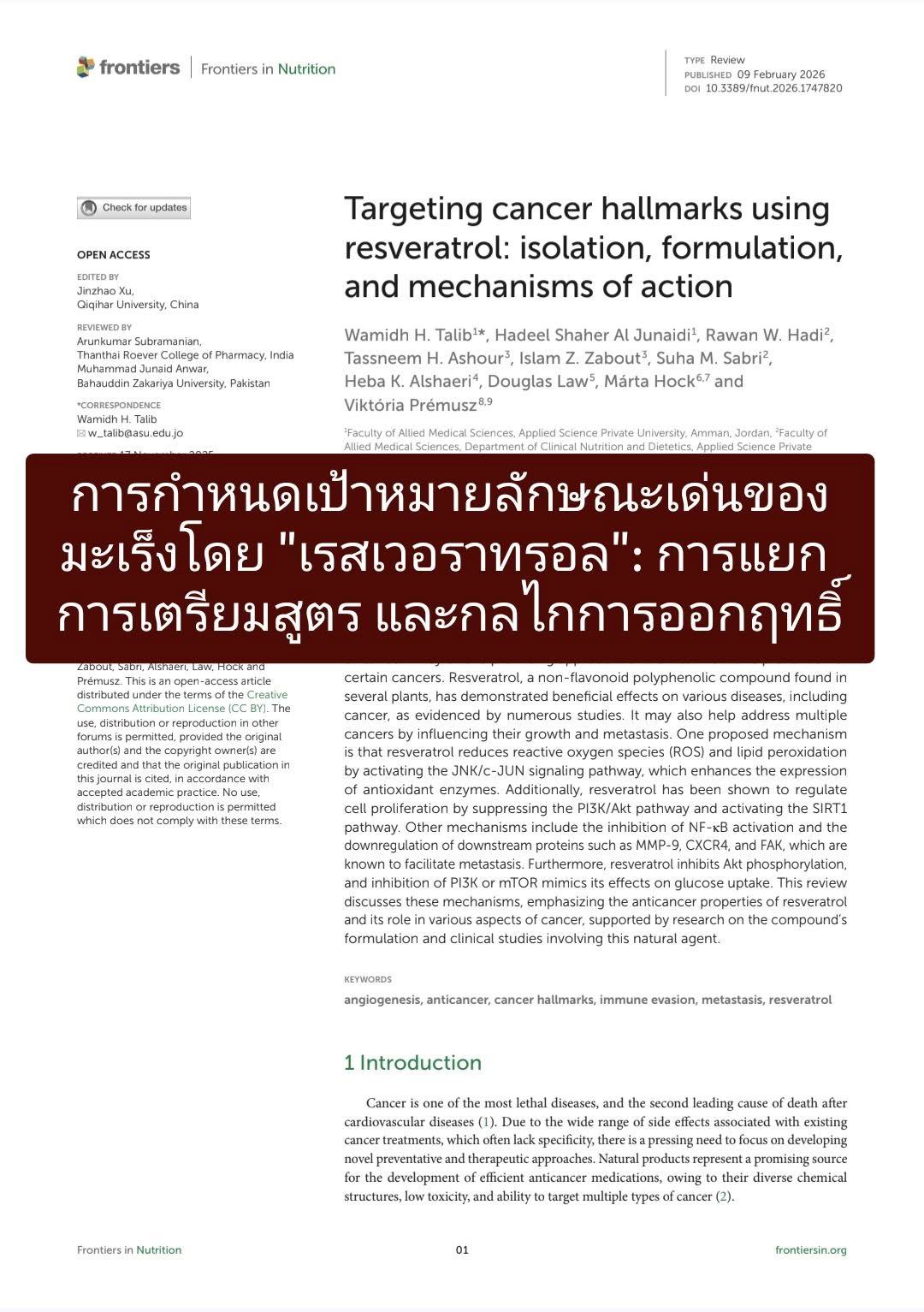
“Targeting Cancer Hallmarks Using Resveratrol: Isolation, Formulation, and Mechanisms of Action”
Published in the journal [Frontiers in Nutrition] in 2026.
Introduction: What is Resveratrol?
Resveratrol is a natural polyphenol. It has outstanding antioxidant properties, reduces inflammation, delays aging, and has the potential to prevent and inhibit cancer.
This article is a Review Article that collects evidence from cellular research, experimental animals, and clinical studies. To explain how Resveratrol attacks “cancer hallmarks,” including methods of extraction, formulation development, and practical limitations.
What are Cancer Hallmarks?
Hallmarks of Cancer are properties that allow cancer cells to grow and spread, such as
1. Stimulates continuous division.
2. Evade cell death
3. Create new blood vessels
4. Spread to other organs
5. Evade immunity
6. Changes in energy metabolism
7. Increases DNA instability
Resveratrol is unique in that it can act on multiple Hallmarks simultaneously.
Resveratrol's anti-cancer mechanism
1. Reduce DNA damage and resist free radicals.
Resveratrol reduces reactive oxygen species that cause DNA mutations by stimulating anti-oxidant enzymes such as SOD, CAT and GPx and promoting the DNA repair system.
2. Inhibits the division of cancer cells
Resveratrol inhibits important signaling pathways such as:
- PI3K/Akt signaling pathway
- Wnt/β-catenin pathway
- Cyclin D1
Causes cancer cells to stop dividing and enter a state of cell cycle arrest.
3. Stimulate the death of cancer cells (Apoptosis)
Resveratrol increases Bax protein and reduces Bcl-2, causing cancer cells to undergo natural death.
4. Stimulate Autophagy
Resveratrol inhibits mTOR and stimulates AMP-activated Protein Kinase, causing cancer cells to lose balance and reduce their survival.
5. Inhibits Telomerase
Resveratrol reduces the expression of hTERT, an enzyme that helps cancer cells endlessly divide.
6. Inhibits the creation of new blood vessels. (Anti-Angiogenesis)
Resveratrol reduces VEGF and HIF-1α levels, causing the tumor to receive less blood and nutrients.
7. Reduce the spread of cancer
Resveratrol inhibits proteins such as MMP-9, CXCR4, and FAK, which are involved in cancer cell invasion and spread.
8. Strengthen the immune system against cancer.
Resveratrol reduces inflammation through inhibiting NF-κB and helps the immune system function well.
Important conclusions
Resveratrol is a natural substance with high anti-cancer potential. Because it can act on many mechanisms simultaneously, including:
- Prevents DNA damage
- Stops the division of cancer cells
- stimulates abnormal cell death
- Reduce the creation of new blood vessels
- Prevent spread
- Enhance immunity
> “Resveratrol Extracted from mulberry, it is a natural substance that has been confirmed by international research to have the potential to inhibit many important mechanisms of cancer cells. Ready to help reduce free radicals, inflammation and support comprehensive cell protection.”